ENGENDERHEALTH
Meeting National Goals and People's Needs with LA/PMs in Ethiopia
The Government of Ethiopia aims to achieve a modern contraceptive prevalence rate (CPR) of 60% by 2010.
2009 · 2 pages
Sign in to readA free account is required to download.
Abstract
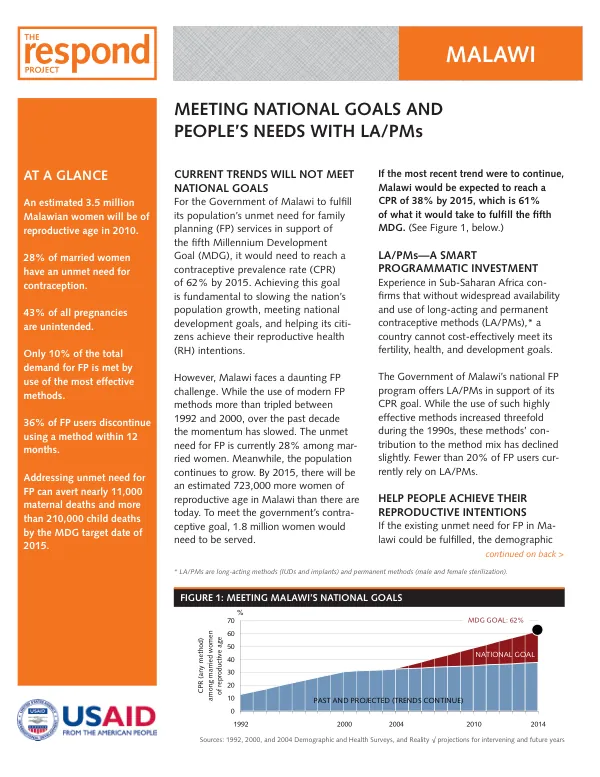
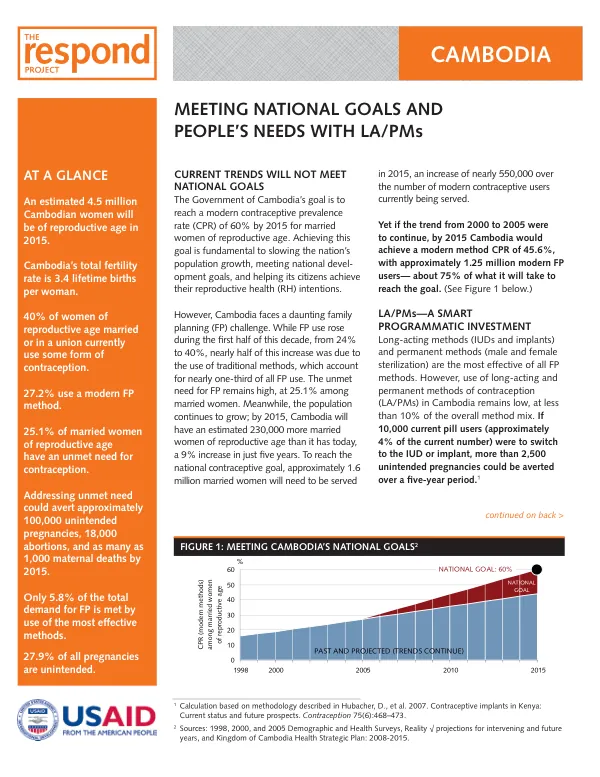
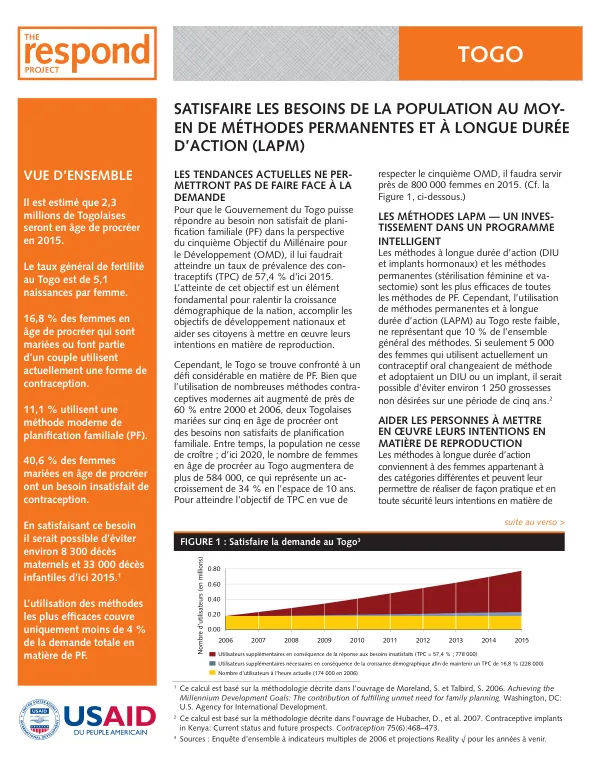
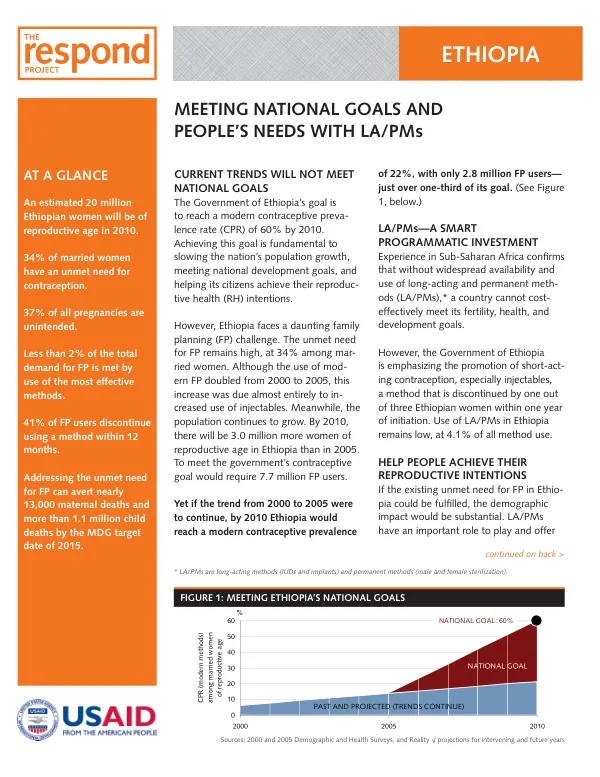
This goal is crucial for slowing the nation's population growth, meeting national development objectives, and enabling citizens to attain their reproductive health (RH) intentions. However, Ethiopia faces a significant family planning (FP) challenge, with an unmet need for FP remaining high at 34% among married women. The use of modern FP methods doubled from 2000 to 2005, primarily due to increased use of injectables. Despite this increase, the population continues to grow, and by 2010, there will be 3.0 million more women of reproductive age in Ethiopia than in 2005. To meet the government's contraceptive goal, 7.7 million FP users would be required. If the trend from 2000 to 2005 continues, by 2010, Ethiopia would reach a modern CPR of 22%, with only 2.8 million FP users, which is just over one-third of its goal. Experience in Sub-Saharan Africa confirms that widespread availability and use of long-acting and permanent methods (LA/PMs) are essential for a country to cost-effectively meet its fertility, health, and development goals. However, the Government of Ethiopia is emphasizing the promotion of short-acting contraception, particularly injectables, which are discontinued by one out of three Ethiopian women within one year of initiation. Use of LA/PMs in Ethiopia remains low, at 4.1% of all method use. If the existing unmet need for FP in Ethiopia could be fulfilled, the demographic impact would be substantial. LA/PMs have an important role to play and offer multiple benefits to programs, women, and couples. The gap between women's expressed reproductive intentions and their method use could be closed by increasing awareness of LA/PMs, correcting misinformation about them, and increasing their availability to expand method choice. Greater access to correct information and to LA/PM services would enable people to meet their changing needs as they progress through their reproductive lives. The RESPOND Project can help the Ministry of Health and the USAID Mission's implementing partners to improve RH in Ethiopia by taking a holistic programmatic approach that addresses the essential components of supply, demand, and advocacy. Possible interventions include the use of Reality √, a cutting-edge forecasting and planning tool, strategies to position specific methods, proven programmatic models to improve and scale up access to FP/RH services, and technical assistance to improve men's constructive engagement in RH and FP programs.