USAID DEC
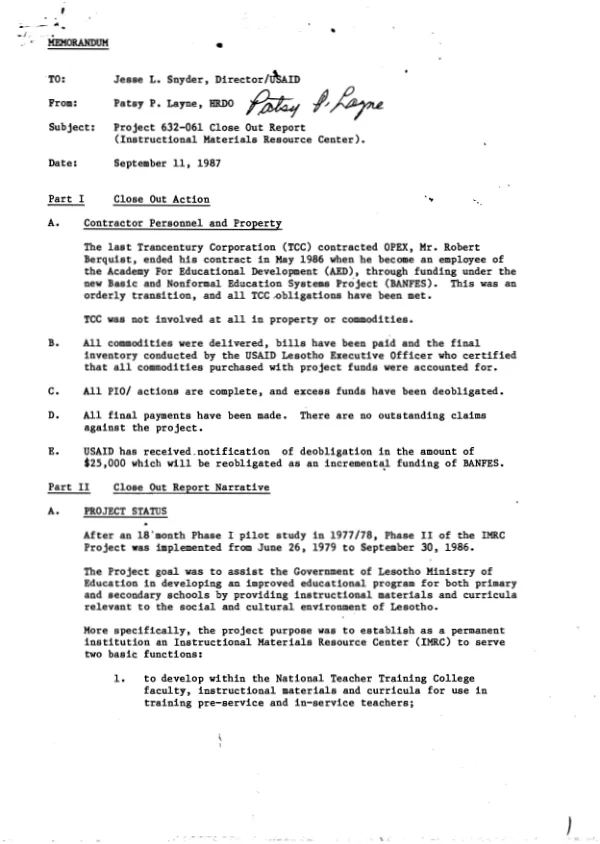
Memorandum to Jesse L. Snyder, Director, USAID on project 632-061 close-out report (Instructional Materials Resource Center)
Sign inUSAID. MISSION TO LESOTHO
Memorandum to Jesse L. Snyder, Director, USAID on project 632-061 close-out report (Instructional Materials Resource Center)
PACR of a project (6/79-9/86) to assist the Government of Lesotho"s Ministry of Education (MOE) in developing an Instructional Materials Resource Centre (IMRC) to provide teacher-training services and instructional materials for primary and secondary schools.
Layne, Patsy P. · 1987
Sign in to readA free account is required to download.
Abstract
All project goals were met or exceeded, and the IMRC has become an integral and respected part of the MOE. The IMRC facility financed by A.I.D. is attractive, functional, and appropriate in design, size, and cost. Through a participant training program, seven IMRC staff members received M.A."s in educational media and two received B.S."s in education from U.S. institutions; six completed courses in production equipment maintenance and operation; and six received certificates in audiovisuals and graphic arts. The project also provided on-the-job training for IMRC staff. The IMRC has 50 clients for its print and audiovisual products (e.g., charts, graphs, textbooks, radio programs, and teacher-training videos) and instructional design and research services. IMRC products are generally as good or better than local commercial quality and produced at a lower cost. The number and type of production jobs have increased steadily each year. The IMRC now has a positive cash flow through its MOE revolving fund deposit account. Less positively, however, the IMRC Instructional Design and Research units are small, unfocused, and insufficiently organized. There is also a need for text editorial services, which currently are not provided by either IMRC or the MOE"s National Curriculum Development Center. The MOE is currently assessing IMRC"s present and potential role as national textbook publisher and/or distributor. USAID/L will assist in long-range planning as part of its Basic and Nonformal Education Systems Project. Lessons learned are: (1) Project designs should allow for maximum strategy flexibility by implementors. (2) Five years is too short for institution building in cultures where the development of different work behavior skills is required. (3) Professional and institutional development were allowed to occur at IMRC because of a high level of staff continuity. (4) Projects must have the capability to provide products and services that are not exactly in line with USAID"s strategies, such as the IMRC"s innovative and potentially controversial media services. (5) IMRC interim evaluations were useful because they involved all staff members. (6) No project design can succeed without the right implementors. High-quality TA was the primary reason for this project"s success.