USAID DEC
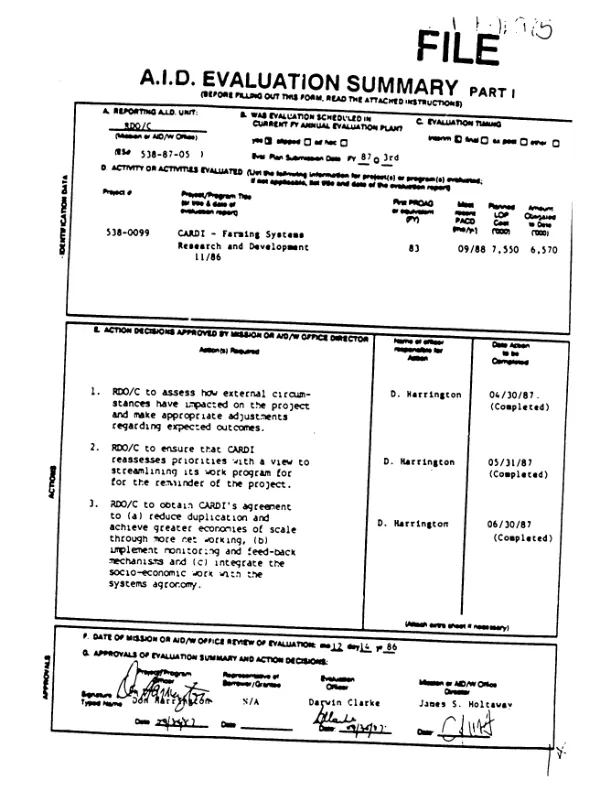
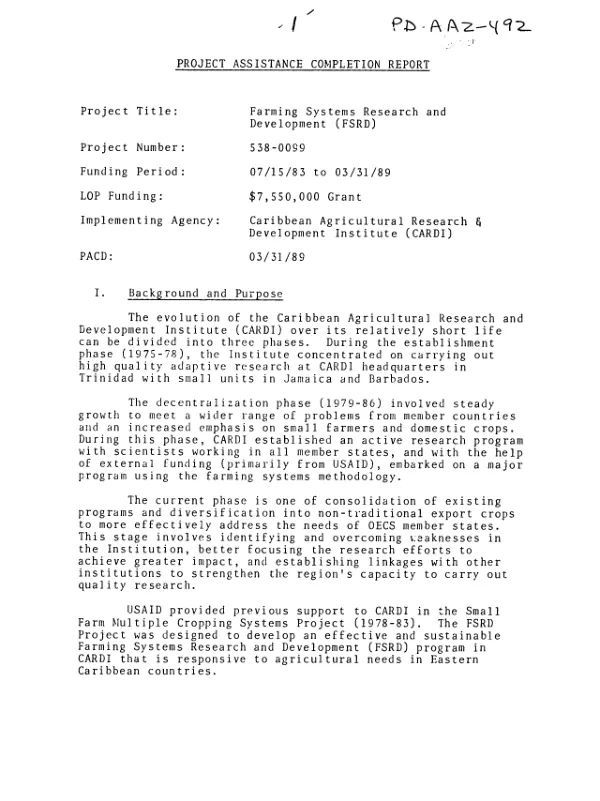
Project assistance completion report : project title, farming systems research and development (FSRD)
Sign inUSAID. BUR. FOR LATIN AMERICA AND THE CARIBBEAN. REGIONAL DEVELOPMENT OFC.
Project assistance completion report : project title, farming systems research and development (FSRD)
PACR of a project (7/83-3/89) to develop a farming systems research and development (FSRD) program within the Caribbean Agricultural Research and Development Institute (CARDI), centered in Trinidad with small units in Jamaica and Barbados.
1989
Sign in to readA free account is required to download.
Abstract
The project was at least partially responsible for transforming CARDI into a viable, financially sound institution. It helped build a cadre of trained CARDI staff and adapted a FSRD methodology suitable to Eastern Caribbean conditions. The project also developed several improved technologies which were adopted at the farm level, including: propagation of yams using "mini-sets"; the identification of a yam variety tolerant to anthracnose; evaluation and release of white and sweet potato varieties; initiation of integrated pest management controls for cabbage insect problems; adaptation and demonstration of topworking of mangoes for export markets; the identification of the causal organism of the tannia "burning" disease along with simple controls which will allow expanded tannia cultivation; and distribution to farmers of improved planting materials for grains and rootcrops. As a result of the project, CARDI developed and implemented a structured annual planning, budgeting, and reporting process; a microcomputer-based management system and strategic plan; a performance appraisal system; and a planning and evaluation unit. Important linkages were also established between CARDI and the South-East Consortium for International Development (SECID), a U.S. group which provided TA in research methodology, personnel management, and computerization, as well as with other regional and international entities. Several lessons were learned. Organizational change is slow in an institution such as CARDI and support is required until these changes become a permanent part of the institutional culture. An institution such as CARDI must develop good internal technical and administrative systems as well as external linkages with regional and international organizations and public and private entities. Long-term TA relationships such as that between CARDI and SECID are mutually beneficial in that host country scientists gain access to TA and training opportunities and U.S. scientists are able to test their assumptions under different geographic and cultural conditions.