MACRO INTERNATIONAL INC.
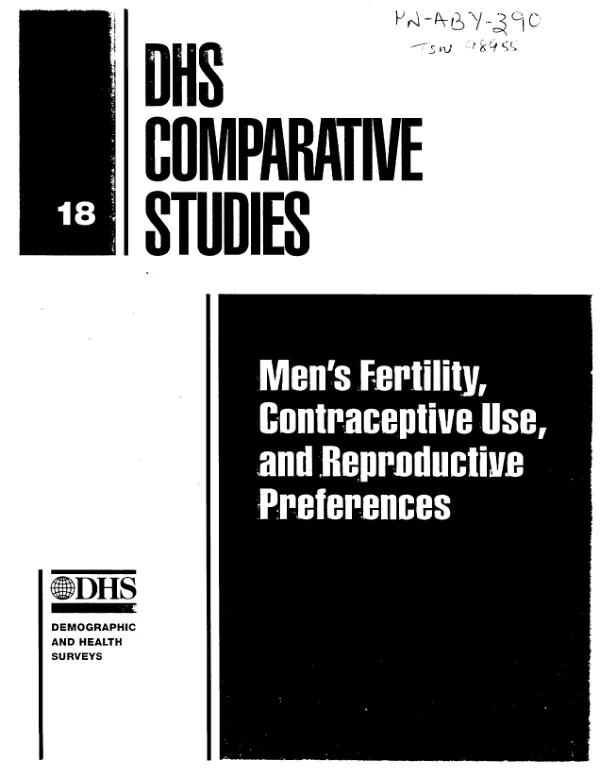
Men"s fertility, contraceptive use, and reproductive preferences
The role of men in the family-building process has been a concern in areas of the world where men are believed to hold views antagonistic to family planning.
Ezeh, Alex C.; Seroussi, Michka +1 more · 1996
Sign in to readA free account is required to download.
Abstract
This report contains the results of 17 DHS surveys conducted over a 7-year period in 15 countries in Africa and Asia, focusing on the information provided by married male respondents to uncover their attitudes, preferences, and behaviors relating to contraception and fertility. To put these findings in perspective, observed levels among men are contrasted with levels among married women in the same country. The first section of the report describes the design and implementation of male surveys in the DHS program, focusing particularly on the selection procedures for the male sample and the differences between a survey of men and a survey of husbands. The second section discusses the background characteristics of the men surveyed and how different selection criteria for male respondents affects the sociodemographic makeup of each sample. Knowledge and use of contraception, intentions to use contraception in the future, and the preferred method for future use are the subjects of the third section. The fourth and fifth sections examine fertility desires and preferences among men. The focus here is on ideal family size, desire for additional children, approval of family planning, and discussion of family planning with wives. Differences in these indicators are examined among currently married men controlling for differences in their background characteristics. The report concludes with a summary of the major findings. (1) In West Africa, men"s mean ideal family size substantially exceeds women"s by 2-4 children, while outside of West Africa, the ideal family size is remarkably similar between men and women. (2) Men generally report higher levels of knowledge of contraceptive methods than women. (3) In almost all surveys, women were more approving of family planning than men. However, the difference is only substantial in West Africa. (4) The preferred methods for non-users who intend to use contraception in the future are similar for men and women, except that men are more likely than women to prefer condoms. Also, men and women give similar reasons for non-use. (5) Overall, the reproductive preferences and attitudes of men and women toward family planning are similar in most countries in East Africa, North Africa, and Asia, and substantially different in West Africa. While Ghana can be distinguished from the other countries in the West African region, Tanzania and Pakistan often share some of the West African characteristics. In these areas especially, men"s reproductive preferences and desires may constitute a major challenge to program success. (Author abstract, modified)