USAID DEC
Methodology for Evaluating Soil and Water Management Under Uncertainty
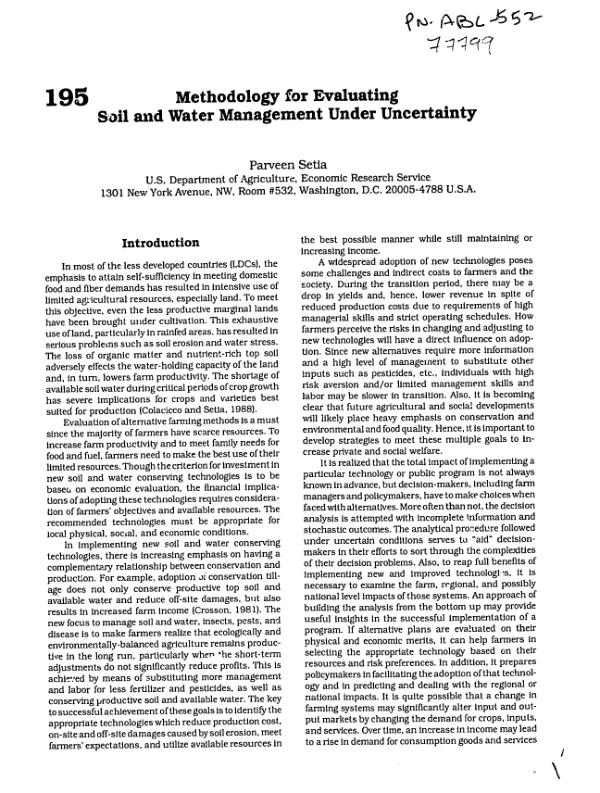
Soil erosion control under risky environment (SECURE) methodology is a comprehensive approach for evaluating soil and water management under uncertainty.
3 pages
Sign in to readA free account is required to download.
Abstract
The methodology is designed to aid decision-makers in selecting the most appropriate conservation systems for farmers, taking into account physical and economic characteristics of the site, as well as stochastic factors such as weather and crop yields. The SECURE methodology consists of six steps, which are outlined in detail in the document. The first step involves estimating soil productivity characteristics, including soil type, topography, and bulk density. This information is used to develop a soil-specific production function, which is then used to simulate crop yields and water balance components. The second step involves crop yield simulation, using models such as SOYGRO and CERES-MAIZE. This step provides simulated biomass and water balance components at selected phenological stages, as well as harvest summary and simulated variables versus time. The third step involves crop enterprise budgets, which are used to estimate net income and total operating costs for each crop enterprise. This information is used to evaluate the economic merits of different conservation systems. The fourth step involves erosion control and soil water management, using models such as SSOILEC and CAMPS. This step provides mean and variance-covariance of net income and soil loss for selected management systems, adjusted for weather, yield, and product price uncertainties. The fifth step involves optimum farm/region plans, using quadratic programming to optimize farm or region plans based on selected decision criteria, such as profit maximization, safety-first, expected utility maximization, and stochastic dominance. The sixth and final step involves policy analysis, which is conducted at the aggregate level. This step evaluates the impact of policy-controlled variables, such as taxes, subsidies, and soil loss quota, on management systems and net farm income. The SECURE methodology is designed to be applied at both micro- and macro-levels, and can be used to evaluate the impacts of adopting selected technologies on farm and regional levels. The methodology is linked with the help of a simulation model, which allows for the evaluation of physical and economic information regarding each conservation system. The methodology is divided into two parts: technical analysis and policy-decision analysis. The technical analysis includes site-specific physical and economic characteristics, while the policy-decision analysis is conducted at the aggregate level. The output of technical analysis provides net income, soil loss, variance-covariance of net income, and soil loss for each system due to stochastic factors identified in the analysis. The results of this analysis provide the foundation for policy analysis, which is conducted at the aggregate level. Various conservation systems are evaluated based on selected decision criteria, such as profit maximization, safety-first, expected utility maximization, and stochastic dominance to reflect the farmer's perception of risk. The SECURE methodology is a comprehensive approach for evaluating soil and water management under uncertainty, and can be applied in evaluating micro- and macro-level impacts of adopting selected technologies. The methodology provides a framework for decision-makers to select the most appropriate conservation systems for farmers, taking into account physical and economic characteristics of the site, as well as stochastic factors such as weather and crop yields. The methodology has important ramifications for overall development in the region, and can be used to evaluate the impacts of adopting selected technologies on farm and regional levels. The SECURE methodology is a valuable tool for decision-makers, policymakers, and farmers, and can be used to make informed decisions about soil and water management under uncertainty.