USAID
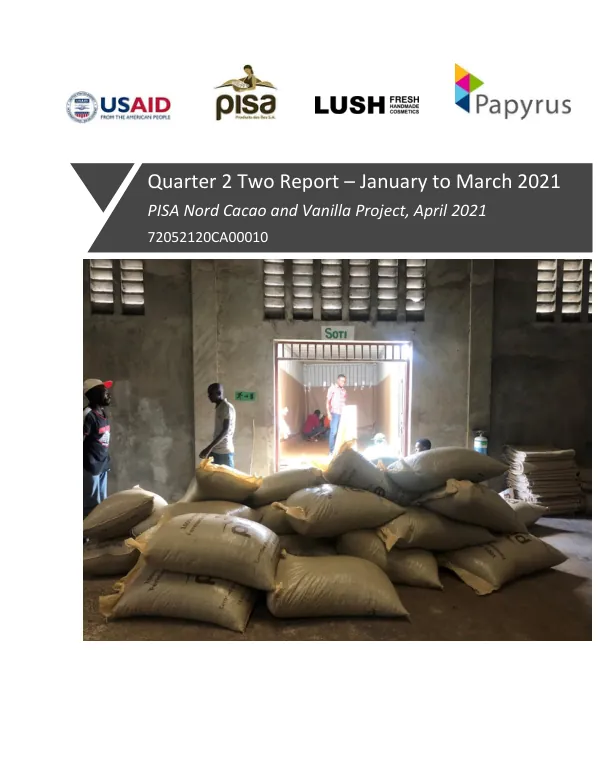
PISA Nord Cacao and Vanilla Project, Year One – Quarter three report
Cacao production and export increased in the first quarter of 2021, with a focus on the main harvest.
2021 · 16 pages
Sign in to readA free account is required to download.
Abstract
The partnership with MARN on the PITAG program to convert a parcel of land into a model clonal garden for cocoa and vanilla has been confirmed, but no agreement has been signed. PISA is improving access to the land and building a depot to stock tools and serve as a guardhouse. The cacao nursery has been repaired after damage from the wind, and composit piles have been turned and are ready to be sieved for soil preparation. Cacao seedling production will resume in July to be ready for transplantation in October-November 2021. Seeds will be collected from APROCANO's producer network. PISA plans to produce 25 to 10,000 seedlings that will be ready to be transplanted by October-November 2021. PISA is also identifying training materials on proper plot management and basic tools to provide coaching and extension services to producers receiving seedlings from the project. The demand for PISA's beans was high this harvest, and some customers had small quantities in their inventory. PISA sorted and organized shipments to respect delivery schedules and have enough space to continue buying. By June 2021, PISA exported five shipments to Europe, Japan, and the USA, totaling 37.31 MT of hand-sorted beans sent to high-quality markets. Two sources of vanilla cuttings have been identified in the Milot area, and around 300 cuttings have been harvested and planted at PISA's vanilla nursery alongside Glyceria as a fast-growing tutor and cacao as shade. Cuttings distribution to 50 producers from APROCANO will be organized during the next rainy season with the cacao seedlings distribution. After sending the corrective actions to the certifier, PISA received its updated FFL and organic certification in April 2021. Data from the organic and FFL producers' survey has been collected and the database updated. A total of 160 producers have been added to the network in Acul du Nord, Bas-Limbé, and Limbé. These producers started selling cacao to PISA this harvest, and their beans have been processed separately and stored as "in conversion." PISA is currently talking to ECOCERT about certifying these producers before the 2021 audit to export their beans as organic before the end of the year and pay farmers the organic premium. The total number of producers in the network is 1,235, with 160 new producers added in the first quarter. The total number of plots is 692, with an estimated production of 2,664 MT and a total area of 1,306.6 Ha. The total number of women producers is 43, and the total number of men producers is 160.