USAID DEC
Methods and Measures to Assess Health Care Provider Behavior and Behavioral Determinants in Reproductive, Maternal, Newborn, and Child Health: A Rapid Review
Sign inENGENDERHEALTH
Methods and Measures to Assess Health Care Provider Behavior and Behavioral Determinants in Reproductive, Maternal, Newborn, and Child Health: A Rapid Review
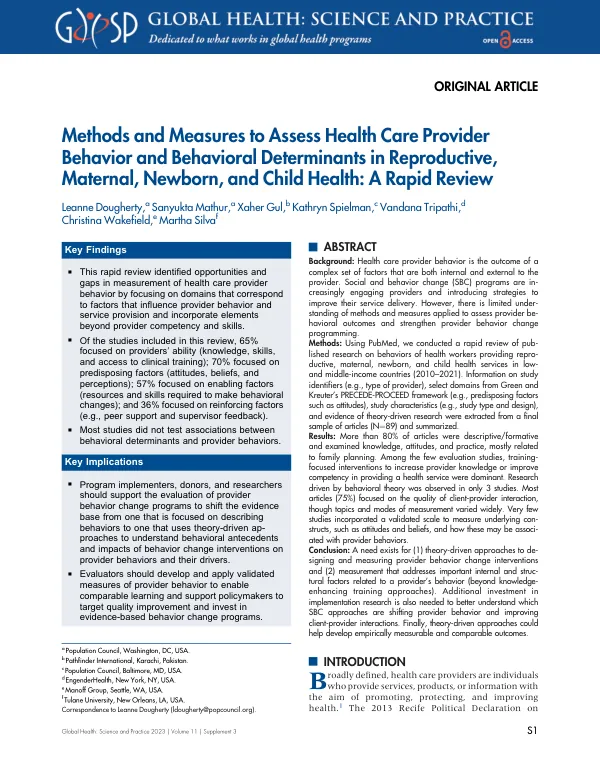
Health care provider behavior is the outcome of a complex set of factors that are both internal and external to the provider.
2023 · 13 pages
Sign in to readA free account is required to download.
Abstract
These factors include attitudes, values, and beliefs, as well as supervisor support, access to professional development, and a supportive workplace environment. The Global Strategy for Human Resources for Health emphasizes the need to optimize health care worker performance, align investments in human resources, build capacity at multiple levels, and strengthen data on human resources for health for monitoring and ensuring accountability. A recent systematic review found that capacity-strengthening for primary health care was predominantly conceptualized in relation to knowledge and clinical skills, with limited reflection on how this translates into competence. Competence is the combination of skills, knowledge, interpersonal and intrapersonal factors, and behavior that providers exercise in delivering high-quality care. Additional systematic reviews have highlighted factors beyond knowledge and skills that influence provider motivation, including financial incentives, career development, and adequate resources and their links to health worker retention and quality care. Health care provider behavior, which includes a range of actions from facility management and adherence to clinical protocols to supervision and client-provider interaction, is influenced by a complex set of factors. In response, health and development programs are increasingly leveraging social and behavior change (SBC) approaches to better engage providers and introducing strategies and tools that reflect on the entire ecosystem of influencers and ensure that they are considered in intervention strategies. A rapid review of the published peer-reviewed literature was conducted to determine what methods and measures have been used to assess provider behavioral outcomes in the area of reproductive, maternal, newborn, and child health (RMNCH). The review aimed to identify and describe methods and measures related to provider behaviors and their drivers and to identify gaps in measurement and opportunities that can inform future PBC strategies. The review included 89 articles published between 2010 and 2021. More than 80% of the articles were descriptive/formative and examined knowledge, attitudes, and practice, mostly related to family planning. Among the few evaluation studies, training-focused interventions to increase provider knowledge or improve competency in providing a health service were dominant. Research driven by behavioral theory was observed in only 3 studies. Most articles (75%) focused on the quality of client-provider interaction, though topics and modes of measurement varied widely. Very few studies incorporated a validated scale to measure underlying constructs, such as attitudes and beliefs, and how these may be associated with provider behaviors. A need exists for theory-driven approaches to designing and measuring provider behavior change interventions and for measurement that addresses important internal and structural factors related to a provider's behavior, beyond knowledge-enhancing training approaches. Additional investment in implementation research is also needed to better understand which SBC approaches are shifting provider behavior and improving client-provider interactions.