USAID DEC
Recurrent Findings in USAID Office of Inspector General (OIG) Performance Audits and Reviews
Sign inINSPECTOR GENERAL’S OFFICE
Recurrent Findings in USAID Office of Inspector General (OIG) Performance Audits and Reviews
The Office of Inspector General (OIG) at the U.S.
2015 · 20 pages
Sign in to readA free account is required to download.
Abstract
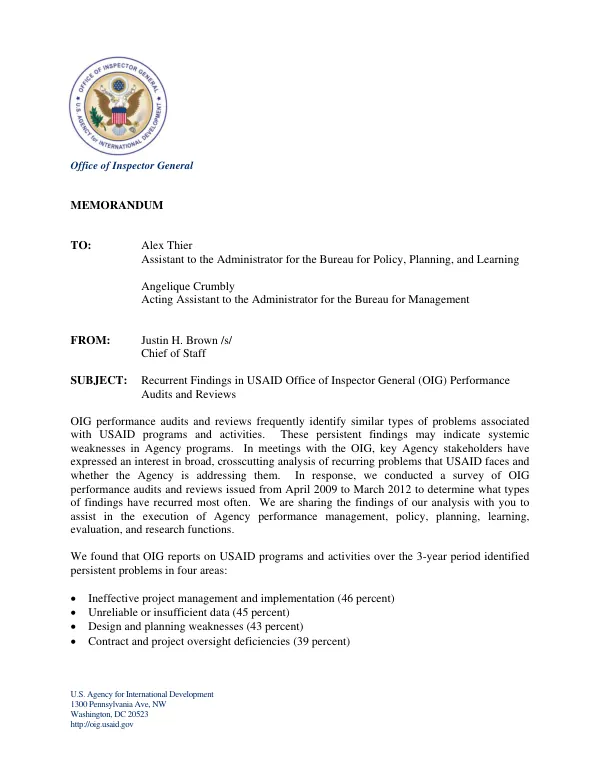
Agency for International Development (USAID) conducted a survey of performance audits and reviews issued from April 2009 to March 2012 to identify recurring problems associated with USAID programs and activities. The analysis aimed to provide a broad, crosscutting analysis of persistent issues faced by the Agency and determine whether USAID is addressing them. The OIG found that OIG reports on USAID programs and activities over the 3-year period identified persistent problems in four areas: ineffective project management and implementation, unreliable or insufficient data, design and planning weaknesses, and contract and project oversight deficiencies. These areas were identified in 46%, 45%, 43%, and 39% of the reports, respectively. Seven in ten OIG performance audits and reviews of USAID programs and activities issued over the 3-year period identified problems in one or more of these areas. Quarterly analysis showed that findings in these areas appeared in a consistently high proportion of reports over time, with more than half of the reports issued during each of the 12 quarters under analysis containing one or more of these types of recurrent findings. The OIG also examined the entity responsible for the identified weakness or deficiency and found that 93% of the time, OIG reports attributed related problems to USAID, with auditors identifying the specific actions or failure to undertake specific actions that resulted in the identified deficiency. However, USAID award recipients were at least partially responsible for underlying problems 79% of the time, and other entities, such as host governments or other U.S. Government agencies, were the source of related difficulties 16% of the time. The OIG did not identify any USAID mechanisms to monitor or respond to recurrent findings in OIG performance audit and review reports. Some USAID officials stated that they had considered analyzing OIG reports for persistent problems but lacked the time and resources to do so. Ineffective project management and implementation were identified as a persistent problem in 46% of OIG reports. Effective project management and implementation practices promote the integrity and success of programs and activities, and USAID personnel are responsible for managing resources to achieve planned outputs and results in a cost-effective and timely manner. The OIG identified several examples of recurrent findings related to ineffective project management and implementation, including the Food for Peace Program in Niger, the Livelihood Development Program in Pakistan, and the Iraq Rapid Assistance Program. These programs experienced weaknesses in management systems, shortcomings in maintaining and reporting needed information, and failures to implement key project activities properly or comply with fundamental contract terms. Findings related to ineffective project management and implementation were more frequently noted in reports on programs in the field than in those on headquarters programs and appeared most often in reports on USAID work in Asia and Africa.