USAID DEC
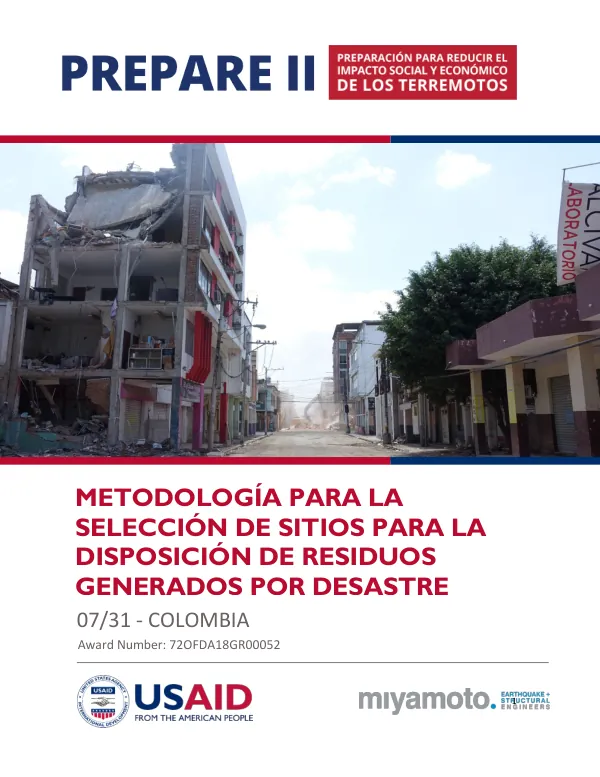
Metodología para la selección de sitios para la disposición de residuos generados por desastre
Sign inUSAID
Metodología para la selección de sitios para la disposición de residuos generados por desastre
The methodology for selecting sites for the disposal of waste generated by disasters in Colombia was developed as part of a project funded by the United States Agency for International Development (USAID).
2019 · 207 pages
Sign in to readA free account is required to download.
Abstract
The project aimed to improve disaster waste management in the country, with a focus on the municipality of Pasto. The methodology proposed for selecting sites for the disposal of disaster waste in Pasto is based on a comprehensive evaluation of various factors, including environmental characteristics, physical characteristics of the territory, and operational variables. The evaluation process involves the definition of variables, assessment of the feasibility of potential sites, and calibration of priority variables. The environmental characteristics evaluated include soil degradation, distance to aquifers, and distance to surface water bodies. The physical characteristics of the territory assessed include geomorphological features, hydrogeological aspects, and elements exposed to the environment. Operational variables considered include terrain slope, distance to the centroid of generation, and distance to infrastructure. The methodology also takes into account the legal framework applicable to waste management in Pasto, including the Plan of Order and Territorial Management (POT) 2014-2027 and the Plan for the Integral Management of Solid Wastes (PGIRS) 2007-2022 and its update in 2015. The selection of sites for the disposal of disaster waste in Pasto was based on a comprehensive evaluation of the variables mentioned above. The results of the selection process are presented in the document, which also includes recommendations for the design, operation, and logistics of waste disposal sites. The document also presents a detailed analysis of the cost estimates for the management of disaster waste in Pasto, including the costs associated with the transportation of waste to disposal sites. The methodology proposed for selecting sites for the disposal of disaster waste in Pasto is a comprehensive and structured approach that takes into account various factors and variables. The results of the selection process and the cost estimates presented in the document provide valuable information for policymakers and practitioners involved in disaster waste management in Colombia. The selection of sites for the disposal of disaster waste in Pasto was based on a weighted evaluation of the variables mentioned above. The weights assigned to each variable were based on their relative importance in the context of disaster waste management. The results of the selection process showed that the most suitable sites for the disposal of disaster waste in Pasto are located in areas with low environmental impact, such as areas with minimal soil degradation and distance to aquifers and surface water bodies. The cost estimates for the management of disaster waste in Pasto were based on a detailed analysis of the costs associated with the transportation of waste to disposal sites. The results of the cost estimates showed that the costs associated with the transportation of waste to disposal sites are significant, but can be reduced through the implementation of efficient transportation systems and the use of alternative transportation modes. The document concludes with a set of recommendations for the implementation of the methodology proposed for selecting sites for the disposal of disaster waste in Pasto. The recommendations include the need for further research and development of the methodology, as well as the need for the implementation of policies and regulations that support the effective management of disaster waste in Colombia.
Related documents
Documents in this collection
 2020
2020USAID DEC
Documento de elementos conceptuales, metodológicos y análisis de las condiciones sociales y económicas de las comunidades localizadas en el área de influencia del Programa Conservación y Gobernanza y del programa de Paisajes Caribe en la región de Montes de María
Open record 2020
2020USAID DEC
![Guía para Evaluación Rápida de Daños y Manual Para diligenciamiento del Formulario de ERD [V2.1]](https://covers.devme.ai/gen/143436.webp)