USAID DEC
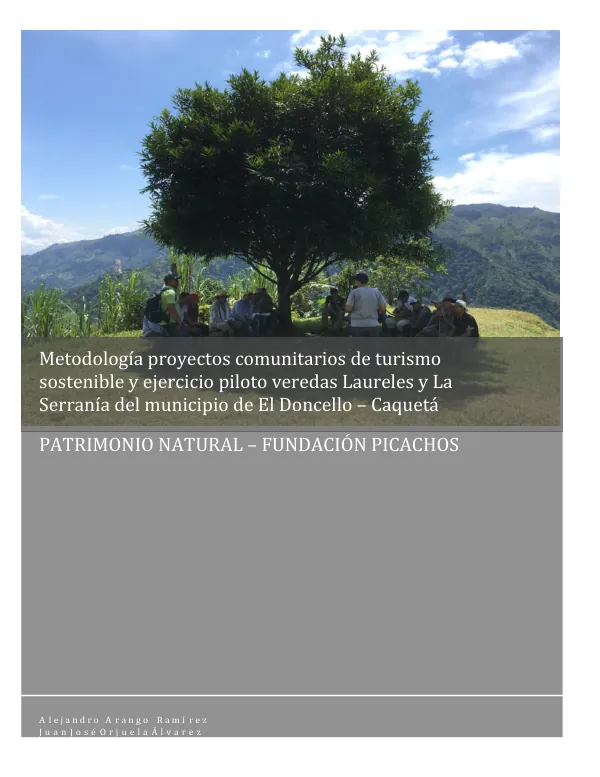
Metodología proyectos comunitarios de turismo sostenible y ejercicio piloto veredas Laureles y La Serranía del municipio de El Doncello – Caquetá
Sign inUSAID DEC
Metodología proyectos comunitarios de turismo sostenible y ejercicio piloto veredas Laureles y La Serranía del municipio de El Doncello – Caquetá
The methodology for community-based tourism projects in El Doncello, Caquetá, was developed to provide a practical guide for articulating concepts and processes related to sustainable tourism development.
2020 · 37 pages
Sign in to readA free account is required to download.
Abstract
The initiative aims to establish a framework for understanding the state of a proposed tourism project and tracing a path for its successful implementation. The document is divided into three main parts. The first part delimits the theoretical aspects of tourism, while the second part presents the methodological framework that guided the work with the El Doncello community. This framework includes a synthesis of methodology that provides a general outline for analysis and diagnosis, planning of action, and implementation of community-based tourism projects. The third part of the document presents the results of the application of the methodology in the diagnostic phase, which was the primary focus of the exercise. This phase was based on a thorough understanding of the community's needs, resources, and potential, as well as the identification of barriers and opportunities for sustainable tourism development. The methodology emphasizes the importance of community involvement and participation in the planning and implementation of tourism projects. It also highlights the need for a sustainable approach to tourism development, which takes into account the conservation of natural resources, respect for local cultures, and equitable distribution of benefits. The document recognizes the complexity of tourism development, which involves multiple stakeholders and disciplines, including social sciences, territorial management, environmental conservation, business modeling, marketing, and others. It also acknowledges the need for creativity and adaptability in the implementation of tourism projects, as each context is unique. The methodology is based on the concept of sustainable tourism, which is defined as a type of tourism that is environmentally friendly, socially responsible, and economically viable. It is characterized by the involvement of local communities in the planning and implementation of tourism projects, which ensures that the benefits are shared equitably and that the local culture is respected. The document presents a typology of tourism, which includes community-based tourism, ecotourism, and rural tourism. Community-based tourism is defined as a type of tourism that involves local communities in the planning and implementation of tourism projects, which ensures that the benefits are shared equitably and that the local culture is respected. The methodology also emphasizes the importance of sustainable tourism practices, which include the conservation of natural resources, respect for local cultures, and equitable distribution of benefits. It also highlights the need for a participatory approach to tourism development, which involves local communities in the planning and implementation of tourism projects. The document presents a case study of the El Doncello community, which was involved in the development of a community-based tourism project. The project was based on a thorough understanding of the community's needs, resources, and potential, as well as the identification of barriers and opportunities for sustainable tourism development. The results of the project showed that community-based tourism can be a viable option for sustainable tourism development, which can generate income and employment opportunities for local communities while preserving the natural and cultural heritage of the area. The document concludes by highlighting the importance of community-based tourism as a strategy for sustainable tourism development, which can generate income and employment opportunities for local communities while preserving the natural and cultural heritage of the area. It also emphasizes the need for a participatory approach to tourism development, which involves local communities in the planning and implementation of tourism projects. The methodology presented in the document provides a practical guide for the development of community-based tourism projects, which can be adapted to different contexts and communities. It emphasizes the importance of community involvement and participation in the planning and implementation of tourism projects, as well as the need for a sustainable approach to tourism development. The document concludes by highlighting the importance of community-based tourism as a strategy for sustainable tourism development, which can generate income and employment opportunities for local communities while preserving the natural and cultural heritage of the area.
![Guía para Evaluación Rápida de Daños y Manual Para diligenciamiento del Formulario de ERD [V2.1]](https://covers.devme.ai/gen/143436.webp)