MEASURE EVALUATION PRH
mHealth for Behavior Change Communication Brief
Mobile messaging has been shown to be successful for many health behaviors, including medication adherence, chronic disease self-management, and disease prevention.
2015 · 6 pages
Sign in to readA free account is required to download.
Abstract
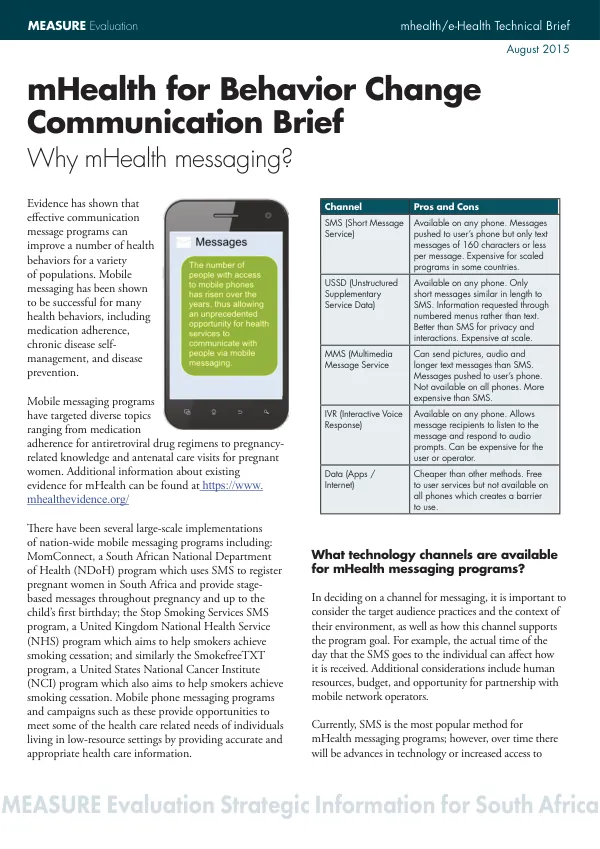
Effective communication message programs can improve a number of health behaviors for a variety of populations. Mobile messaging has been targeted towards diverse topics ranging from medication adherence for antiretroviral drug regimens to pregnancy-related knowledge and antenatal care visits for pregnant women. Several large-scale implementations of nation-wide mobile messaging programs have been conducted, including MomConnect, a South African National Department of Health program which uses SMS to register pregnant women in South Africa and provide stage-based messages throughout pregnancy and up to the child's first birthday. The Stop Smoking Services SMS program, a United Kingdom National Health Service program, aims to help smokers achieve smoking cessation, while the SmokefreeTXT program, a United States National Cancer Institute program, also aims to help smokers achieve smoking cessation. Mobile phone messaging programs and campaigns provide opportunities to meet some of the healthcare-related needs of individuals living in low-resource settings by providing accurate and appropriate healthcare information. In deciding on a channel for messaging, it is essential to consider the target audience's practices and the context of their environment, as well as how this channel supports the program goal. Currently, SMS is the most popular method for mHealth messaging programs; however, over time, there will be advances in technology or increased access to technology that may change the way people use mobile phones. Therefore, it is critical to constantly assess the appropriateness of the existing channel and seek opportunities for the addition of other channels or integration of multiple channels for enhanced delivery of messages. Developing a mHealth messaging program is an iterative process that requires input from various stakeholders, including potential/ideal/intended users of the program. The program must be consistent with the best scientific and practice-based evidence and must also follow general principles of communication in order to make sure that the information is accurate, easy to read, and leads to improved health. The 10-step process for developing a mHealth messaging program includes identifying the messaging team and program manager, specifying exactly what the program aims to address through messaging, creating a messaging program framework, developing the messaging content, determining the frequency of message delivery and amount of messages, deciding on whether the program will only provide messages to recipients or allow two-way communication, developing guidelines for resource recommendations and referrals, determining the message tone, and testing and evaluating the messaging program. The messaging team should be interdisciplinary to ensure that the perspectives of all key stakeholders are represented during the development of the messaging program. The program manager serves a critical role in keeping the project on schedule and convening the appropriate stakeholders and consolidating their input. The program scope and goal should be defined using a SMART sentence, which helps to ensure that results are specific, measurable, achievable, relevant, and time-based. The messaging program framework should be developed to ensure consistency throughout the program and provide input on important aspects of the program early in the process. Guiding behavioral theories and message frames should be identified and outlined in the context of the program goals and target population. Messaging content should be written with consideration of the target user's perspective and the context in which they might receive the message. The frequency of message delivery and amount of messages should be determined, considering factors such as whether messages need to be delivered in a particular order or at random, and whether a greater amount of information is more pertinent at a particular stage. A decision should be made on whether the program will only provide messages to recipients or allow two-way communication, enabling message recipients to interact with the program.