USAID DEC
Good Practices for the Implementation and Management of a National Master Patient Index
Sign inMEASURE EVALUATION PRH
Good Practices for the Implementation and Management of a National Master Patient Index
The National Master Patient Index (MPI) is a critical component of the South African National eHealth strategy, aimed at improving the flow of information to support the delivery of health services and management of health systems.
2015 · 4 pages
Sign in to readA free account is required to download.
Abstract
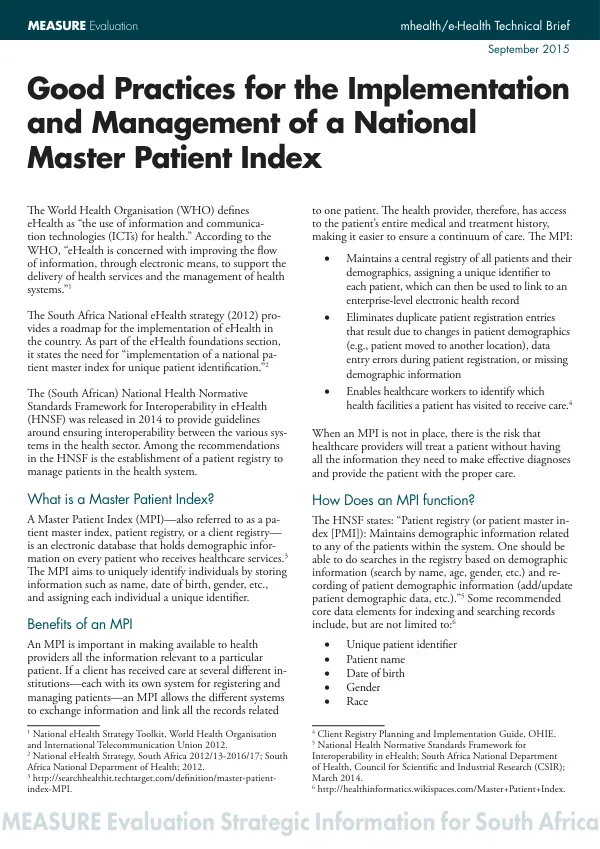
The MPI is an electronic database that holds demographic information on every patient who receives healthcare services, with the primary goal of uniquely identifying individuals by storing information such as name, date of birth, gender, and assigning each individual a unique identifier. The MPI benefits healthcare providers by making available all relevant information for a particular patient, eliminating duplicate patient registration entries, and enabling healthcare workers to identify which health facilities a patient has visited to receive care. Without an MPI, healthcare providers risk treating patients without having all the necessary information to make effective diagnoses and provide proper care. The MPI functions by maintaining demographic information related to patients within the system, allowing for searches based on demographic information and recording of patient demographic data. Recommended core data elements for indexing and searching records include unique patient identifier, patient name, date of birth, gender, ethnicity, address, alias/previous name, biometrics, and national identification number/passport number. Maintaining a nationwide MPI requires processes for data cleaning, removing duplicates, and merging or splitting records where needed. A record that cannot be resolved by the MPI will not be correctly linked to the patient's electronic health record (EHR), affecting the continuum of care. It is essential to ensure that health information identifiers are recorded whenever a patient seeks care, using these identifiers to determine if a patient seen at two different facilities is the same person. Robust matching algorithms are critical for an MPI, employing both deterministic and probabilistic methods to match records. Deterministic methods search for exact matches, while probabilistic methods search for approximate matches. This combination of methods allows the MPI to link two records where a client used different names on different occasions, but other aspects of their information match up. Language and localisation are significant factors to consider when implementing an MPI, as names can be spelled differently depending on origin or due to misspellings. MPI algorithms should be structured around phonetic spelling and identification of names to deal with these types of language- and culture-related factors. The quality of the data in an MPI is dependent on the staff that process and register patients at health facilities. Capturing information accurately during registration is the first line of defense, but people sometimes make mistakes, resulting in duplicates, overlays, and overlaps. It is essential to ensure that staff who conduct patient registrations are competent and receive refresher trainings regularly. Stringent monitoring of the information contained in the MPI is needed to ensure data integrity, with a team of professionals responsible for evaluating the most difficult cases of mistaken identity and potential duplicate records. The team will need to continuously monitor matching rules to determine whether the algorithms need to be tweaked. The Open Health Information Exchange (OpenHIE) community has released the OHIE Client Registry Planning and Implementation Guide, which provides guidance for the end-to-end implementation of an MPI. The guide is based on past experiences and implementations, offering valuable insights and best practices for implementing a national MPI.