DAI
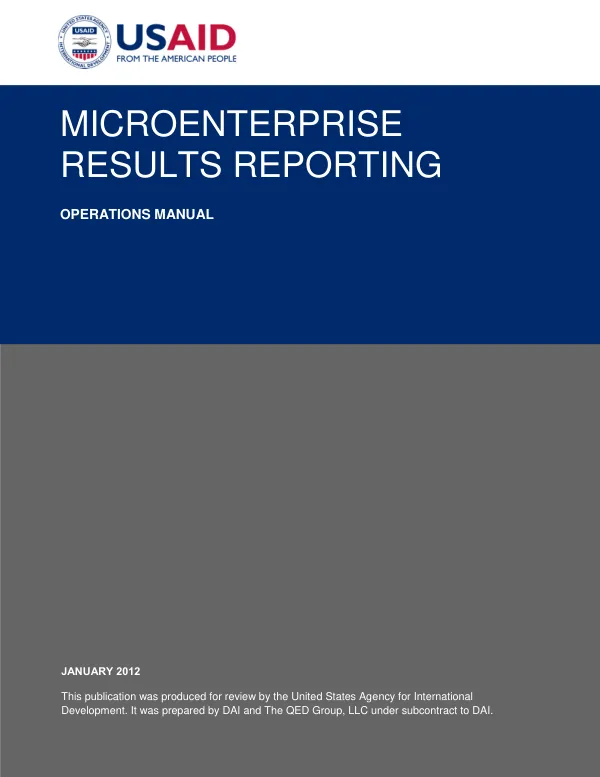
Microenterprise Results Reporting Operations Manual
The Microenterprise Results Reporting Operations Manual is designed to guide USAID's MRR implementer through the annual reporting cycle.
2012 · 57 pages
Sign in to readA free account is required to download.
Abstract
The manual is a reference for MRR's project manager and analysts, explaining how to execute the project successfully, on time, and within budget. It contains detailed definitions used to classify USAID's microenterprise development projects, the yearly timeline and process for collecting mission and partner data, and descriptions of how the MRR website facilitates annual data collection. The primary elements of the MRR project include USAID Mission/Operating Unit data collection and review, USAID Implementing Partner data collection and review, and the production of an Annual Report to the U.S. Congress. Each element is described in more detail in the following sections of the manual. The project timeline is outlined in the manual, with four tasks - A through D - corresponding to the primary elements of the project. Task D, the management and maintenance of the MRR website, is an ongoing task throughout the project. USAID Field Missions are responsible for reporting data on funding that pertains to microenterprise development. They report primarily on the most recently completed fiscal year, but also on planned obligation amounts for the subsequent fiscal year (when possible). Mission data include allocation and obligation information, implementing mechanism information, implementing partner name and contact information, and Mission contact information. When allocations for microenterprise development cannot be clearly distinguished from other program funds, MRR requests that funds be "pro-rated" to reflect the estimated percentage of the funding that supports microenterprise development. USAID/Washington Offices provide funding to microenterprise development activities and must also report to MRR. They are asked to provide the same data that the USAID field Missions are asked to provide. Implementing Partners, or Partner Organizations, are institutions that have been designated by USAID Missions as recipients of USAID obligations. These partners are responsible for entering program data on their microenterprise-related activities. Microfinance institutions (MFIs), institutions providing enterprise development (ED) services, and policy advocacy institutions enter results data on their activities. The MRR website was redesigned in 2009 to be easy to use, with clear and concise screens that follow a customized workflow based on the data the user needs to enter. The system also contains context-sensitive help and built-in intelligence that reviews data for common errors. From time to time, changing legislative requirements, refinements of microenterprise development terminology, and enhancements in USAID programming require updates to the MRR surveys and system. The operations manual will be updated periodically to reflect these improvements when they have a material impact on the process and timeline used to collect data. The MRR team should verify the current list of active Missions and Washington Operating Units that need to report to MRR with the MRR COTR in the Office of Microenterprise Development prior to Mission data collection. For Missions that are known to have high staff turnover, such as Iraq, Sudan, or Afghanistan, or for Missions identified by the MRR COTR for additional follow-up, the MRR team can contact country desk officers to confirm Mission contacts. A current list of Mission contacts can be found in Annex F. The MRR team should also consider special circumstances and requests by USAID Missions and Operating Units. For example, in FY 2008 and FY 2009, the Regional Development Mission/Asia (RDM/A) requested that MRR not contact their implementing partners directly to collect data. Instead, they asked that Mission staff be provided with the partner data request and login capability to complete the partner survey.