USAID DEC
HOW THE PRIVATE SECTOR MEASURES SOCIAL INCLUSION AND ITS RETURN ON INVESTMENT: A FRAMEWORK TO INFORM FUTURE RESEARCH
Sign inDAI
HOW THE PRIVATE SECTOR MEASURES SOCIAL INCLUSION AND ITS RETURN ON INVESTMENT: A FRAMEWORK TO INFORM FUTURE RESEARCH
The Feed the Future Market Systems and Partnerships (MSP) Activity is advancing learning and good practice in market systems development (MSD) and private sector engagement (PSE) within USAID, USAID partners, and market actors.
2021 · 5 pages
Sign in to readA free account is required to download.
Abstract
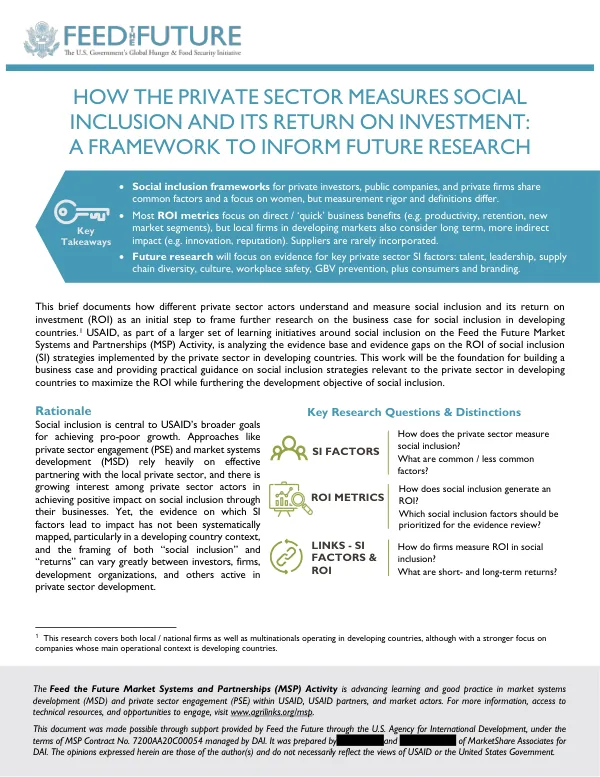
For more information, access to technical resources, and opportunities to engage, visit www.agrilinks.org/msp. Social inclusion is central to USAID's broader goals for achieving pro-poor growth. Approaches like private sector engagement (PSE) and market systems development (MSD) rely heavily on effective partnering with the local private sector, and there is growing interest among private sector actors in achieving positive impact on social inclusion through their businesses. Yet, the evidence on which social inclusion factors lead to impact has not been systematically mapped, particularly in a developing country context, and the framing of both "social inclusion" and "returns" can vary greatly between investors, firms, development organizations, and others active in private sector development. The research team reviewed existing social inclusion frameworks and indices developed by the private sector to document commonly and less commonly utilized social inclusion factors. The main focus is on gender equality and women's empowerment, with gender-lens investing an increasingly established field. Many of the global frameworks and indices developed by the private sector focus on diversity from a gender perspective. Frameworks for other target groups, such as LGBTQI and racial equity, are emerging, yet remain less established and not yet publicly available. There are three main private sector subsets to consider when measuring social inclusion: private investors, public companies, and private firms. The more commonly used social inclusion frameworks and indices are derived for private investors, public companies, and private firms. Governments and other development actors, such as multilaterals like the World Bank, also play a significant role in defining and promoting social inclusion in private sector development, but from the perspective of economic growth and impact on macroeconomic metrics like GDP. The research team documented how firms are measuring the return on investment (ROI) as it relates to social inclusion. The most commonly measured factors are talent, leadership, supply chain diversity, consumers, culture, policies, and community impact. Factors that are less common include workplace safety and gender-based violence (GBV), accountability, pro-women branding, enabling environment, and compensation. The subset of private sector actor influences the types of social inclusion factors they measure, with the "business case" for investors not the same as that for firms, and public companies usually facing a higher level of scrutiny than private firms. A framework with hypotheses on the link between social inclusion factors and the ROI has been developed based on the initial research, which will be substantiated through upcoming research. The framework includes the following social inclusion factors: talent, leadership, supply chain diversity, consumers, culture, policies, and community impact. The research will focus on evidence for key private sector social inclusion factors, including talent, leadership, supply chain diversity, culture, workplace safety, GBV prevention, and consumers and branding. The research will also examine the ROI metrics used by private sector actors, including direct and indirect benefits, such as productivity, retention, new market segments, innovation, and reputation. The research will provide a foundation for building a business case and providing practical guidance on social inclusion strategies relevant to the private sector in developing countries to maximize the ROI while furthering the development objective of social inclusion.