USAID DEC
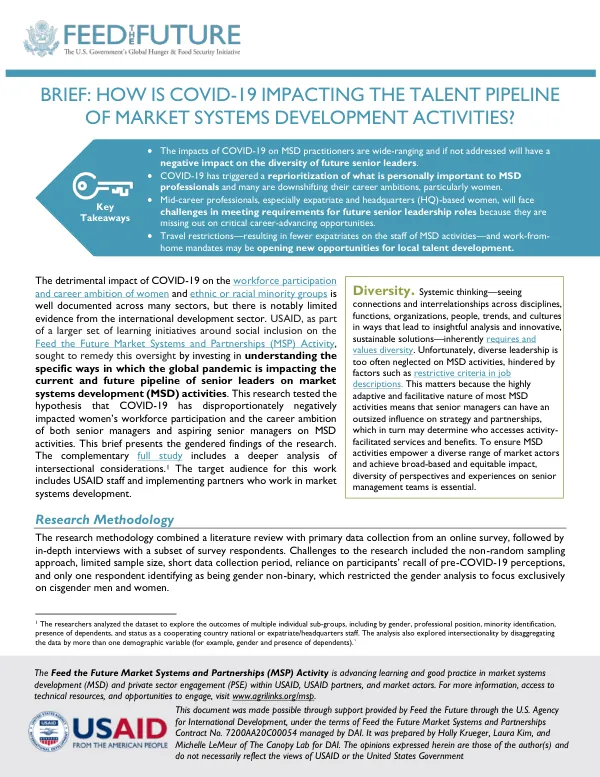
Study: How is COVID-19 Impacting the Talent Pipeline of Market Systems Development Activities?
Sign inDAI
Study: How is COVID-19 Impacting the Talent Pipeline of Market Systems Development Activities?
Market systems development (MSD) practitioners are experiencing wide-ranging effects from the COVID-19 pandemic, which are already impacting morale and, if not addressed, will have a negative impact on the diversity of current and future senior leaders.
2021 · 13 pages
Sign in to readA free account is required to download.
Abstract
Increases in both work and household demands have put a strain on MSD professionals, with senior-positioned women and women with young dependents being among the groups most at risk. Women and men without dependents and those who experienced a decrease in unpaid care work are also reporting untenable situations. There is widespread pessimism about employment prospects, with men, including those who identify as an ethnic or religious minority, being among those most concerned. Expatriate and headquarters (HQ)-based MSD professionals, particularly women, are facing increasing obstacles to career advancement. Mid-career MSD professionals, and expatriate and HQ-based women in particular, will face challenges in meeting requirements for future senior leadership roles because they are missing out on critical career-advancing opportunities, such as technical field work, networking, capacity building, and quality interaction with managers. At the same time, global travel restrictions may be unlocking new opportunities for local talent development. The reduction in expatriate/HQ staff travel to field offices may be creating opportunities for cooperating country nationals (CCNs) and women CCNs in particular. These groups are reporting an increase in exposure to technical work and networking opportunities. CCN women are also among those most likely to believe their eligibility for senior leadership roles has increased during COVID-19. The research methodology combined a literature review with primary data collection. A rapid online survey was disseminated through multiple channels, including social media networks, emails, listservs, and networking and learning platforms. The questionnaire collected data on respondents' demographic information, their answers regarding the effects of COVID-19 on various aspects of their work and personal lives, as well as the effects of COVID-19 on their career outlook and ambitions. The researchers also conducted in-depth interviews with 21 respondents to probe and provide context for the survey findings. The survey respondent group was geographically diverse, with 48 nationalities represented. Around 60 percent of the respondents were from high-income countries, 34 percent from middle-income countries, and over 5 percent from low-income countries. The ages of the respondents ranged from 25 to over 65 years old, with the majority of respondents between the ages of 30 and 44 years old. More than two-thirds of respondents were expatriates or HQ-based staff, with just under two-thirds self-reporting as being in a "senior position" and just over one-third reporting being in a "mid-career position." Women were more represented in the mid-career position category, and men were more represented in the senior position category. Key findings from the research include that MSD professionals are pessimistic about their future employment prospects, particularly men, and especially men who identify as a minority. Over 70 percent of MSD professionals now believe it is "somewhat hard" or "very hard" to find a job in the next six months. Women are also reporting a decrease in their career ambition, with over 60 percent stating that they are less likely to pursue a senior leadership role in the next two years. The research highlights the need for USAID and implementing partners to address the challenges faced by MSD professionals, particularly women and minority groups, to ensure the diversity of perspectives and experiences on senior management teams.