USAID DEC
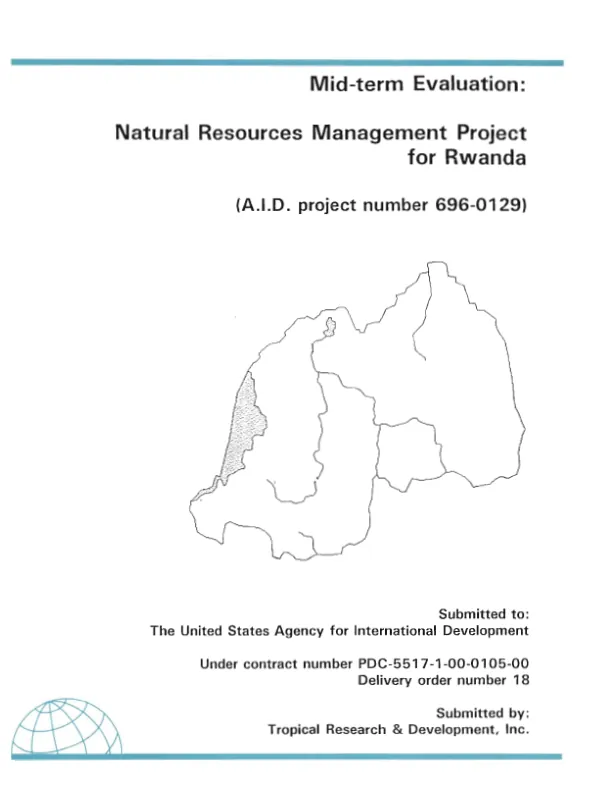
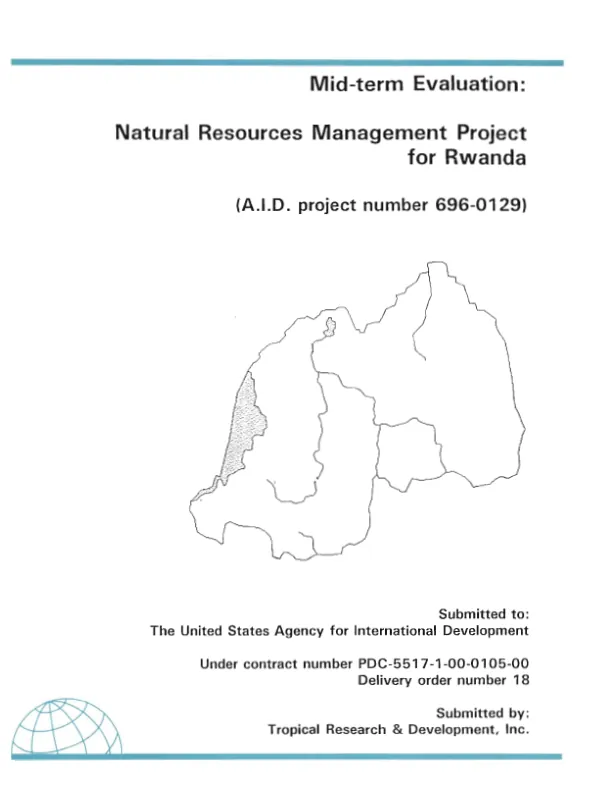
Mid-term evaluation : natural resources management project for Rwanda (AID project number 696-0129)
Sign inTROPICAL RESEARCH AND DEVELOPMENT, INC.
Mid-term evaluation : natural resources management project for Rwanda (AID project number 696-0129)
Midterm evaluation of a project to improve natural resources management in Rwanda.
Brusberg, Frederick; LeBloas, Jean · 1993
Sign in to readA free account is required to download.
Abstract
The evaluation covers the period 6/89-12/92. Progress has been slow due to poor performance by the project Coordination Unit (CU), which has yet to set up an effective management system. Other delaying factors have included the inherent difficulty of managing a project with five such disparate components, confusing inconsistencies in the component agreements with USAID, and several changes in Rwandan and USAID project personnel. The CU has spent less than 50% of its annual budget allocations over the last 2 years. The absence of overall management by the CU has detracted from the performance of the individual components, and has forced USAID/R to assume many of the CU"s responsibilities, such as assisting components with accounting and reporting procedures; this has created a situation in which component personnel feel that USAID is micromanaging the project, while USAID is concerned about the unanticipated workload for Mission staff. Individual components have managed to achieve varying degrees of success. (1) The marais lands (bottomlands) research and management component has completed the basic research needed for development of the Nyamigogo marais, and 21 of 30 targeted rural engineering technicians are being trained. Another 30 are needed. (2) While less successful, the marais fish culture component has made significant progress toward targets, suggesting this may be a viable smallholder activity. A national aquaculture plan should be completed as soon as possible. (3) The soil conservation and agroforestry component will probably not attain its targets and should be scaled back. (4) The natural forest management component has succeeded in encouraging the participation of Rwandan professionals. Given the economic importance of ecotourism for Rwanda, expansion of this component to Akagera National Park should be considered. (5) The environmental planning component has assisted Rwanda"s new Ministry of Environment and Tourism (MINETO) in implementing the National Environmental Strategy and the Environmental Action plan, and has provided other support as well. However, MINETO is a small ministry with very limited capacity and an ill-defined mandate vis-a-vis other ministries with environmental concerns. The project should encourage the development of a national environmental council that can identify intra-ministerial and sectoral responsibilities in environmental management. MINETO should be given training support in addition to TA.
Related documents