USAID. BUR. FOR PROGRAM AND POLICY COORDINATION. CENTER FOR DEVELOPMENT INFORMATION AND EVALUATION (CDIE)
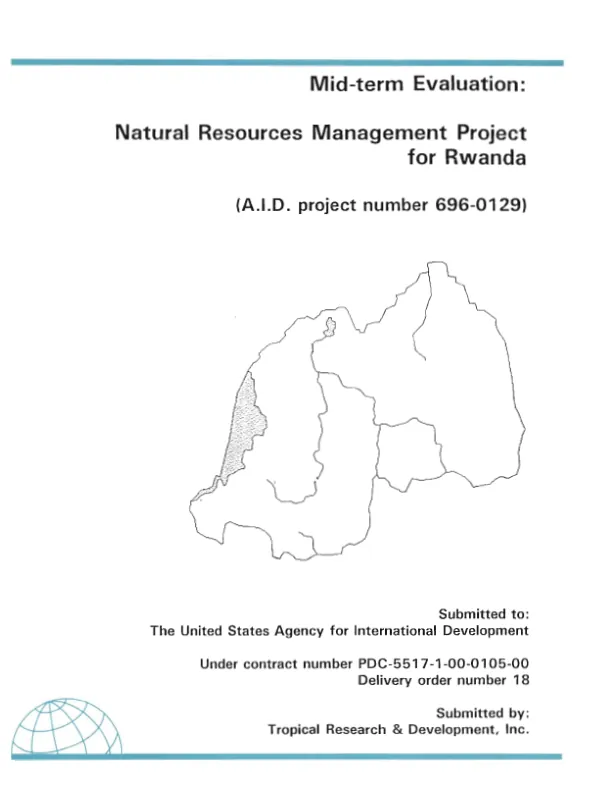
Natural resources management : issues and lessons from Rwanda
Rwanda is an exception among low-income developing countries in that it has given high priority to environmental and natural resource management (NRM) issues.
Chew, Siew Tuan · 1990
Sign in to readA free account is required to download.
Abstract
This paper describes A.I.D.'s support for these efforts and explores the possibility of integrating them into agricultural and rural development programs in Rwanda and elsewhere in sub-Saharan Africa. Major findings are as follows. (1) Government support is a prerequisite to developing the long-term strategies needed to address specific NRM issues. (2) Developing appropriate NRM technologies is a complex undertaking requiring site-specific applied research. (3) Donors should appreciate the difficulty host countries face in balancing NRM with development, conservation, and equity objectives. (4) USAID/Rwanda assistance has covered a wide range of NRM activities, many of them complementary to those of other donors, some part of a coordinated multi-donor effort. Such collaboration is especially necessary in complex projects. (5) The Mission's program includes several innovative and potentially replicable approaches, including the promotion of ecotourism in conjunction with wildlife conservation and park management, and agroforestry and fish farming to conserve soil and water resources while increasing farm productivity. Since such activities often require costly investments and yield their ecological and economic benefits only in the long term, a broader framework than simple cost-benefit analysis might be needed in attempting to incorporate them into USAID/Rwanda's agricultural and rural development portfolio.