CHECCHI AND CO. CONSULTING, INC. (CCCI)
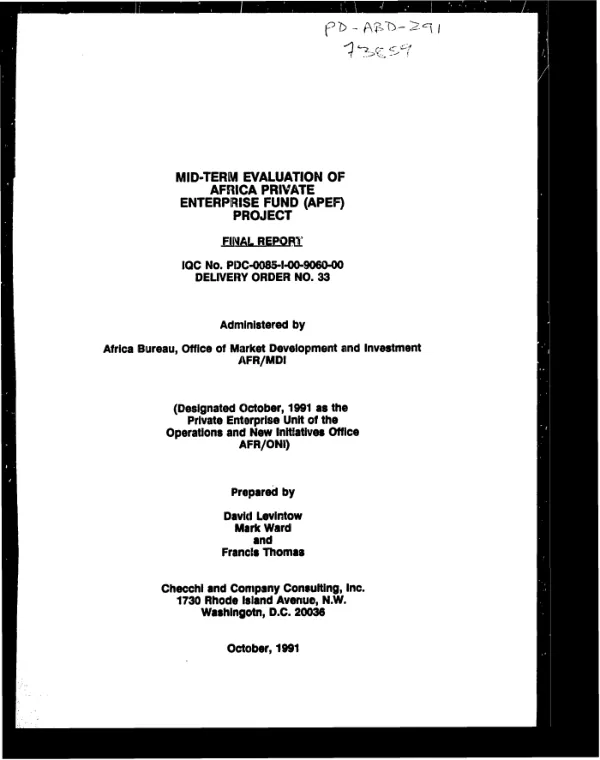
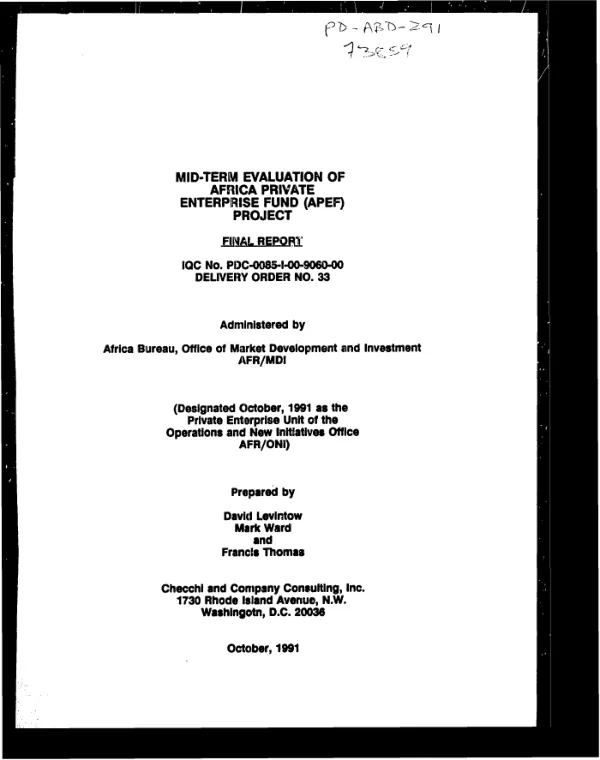
Mid-term evaluation of Africa private enterprise fund (APEF) project
Mid-term evaluation of a project to promote private sector development in Africa.
Levintow, David|Ward, Mark|Thomas,Francis · 1991
Sign in to readA free account is required to download.
Abstract
The evaluation covers the period 1988- 1991. The project is being implemented by the Africa Bureau's Office of Market Development and Investment (AFR/MDI), with support from private contractors. End-of-project targets established in 1988 were generally reached by mid-1991. These include having Missions integrate private sector work into their country strategies, assisting African governments with privatization efforts, establishing multiple new credit facilities, and facilitating policy changes in many priority countries. More specific efforts have included: (1) technical assistance and funding to promote trade missions, evaluate export processing zones, develop agribusiness activities, and support small businesses; (2) creation of innovative financial sector programs including policy reform measures, credit facilitation, debt swap exchanges, and venture capital promotion; (3) joint funding of major private sector development programs with other donors and U.S. agencies; and (4) matchmaking activities with U.S. and African businesses. Efforts to stimulate private sector development in a region long dominated by socialist-minded leaders have been outstandingly innovative, and individual programs have generally been managed satisfactorily, though coordination and follow up have sometimes been lacking. Most programs, although only having been conducted in the past 1-3 years, appear to have had a modestly positive if generally unmeasurable impact. On the negative side, despite Africa's growing sense of economic realism and appreciation of the importance of the private sector in economic development, the slow pace of economic reform and bureaucratic rules and practices that delay commitments and preclude risk taking have posed a major constraint to the project. Other findings are as follows. (1) The decision to support multiple, sometimes precedent-establishing promotional programs has been appropriate during a period when African leaders and most Missions were starting to appreciate the justification for private sector led growth. (2) Efforts to channel AFR resources through organizations such as the multilateral African Project Development Facility (APDF), and the Overseas Private Investment Corporation (OPIC), have been particularly successful in leveraging major incremental commitments by those organizations. (3) Use of contract personnel to augment the work of A.I.D. direct hires has been effective and should continue. (4) Although some services provided by MDI to missions, e.g., privatization and finance operations, are duplicated through centrally funded PRE operations, Missions generally prefer to use MDI resources. PRE officials have expressly cited a desire to collaborate more closely with private sector programs in Africa. Other A.I.D. private sector offices, such as those in the Latin America and Asia bureaus, are currently retrenching efforts to directly influence the role of the private sector in host countries, opting instead for limited interventions through private intermediaries such as chambers of commerce and joint business/governmental groups, and for policy dialogue. Such a policy is not yet an appropriate short-term model for Africa, given the region's economic backwardness and lack of private institutions.