USAID DEC
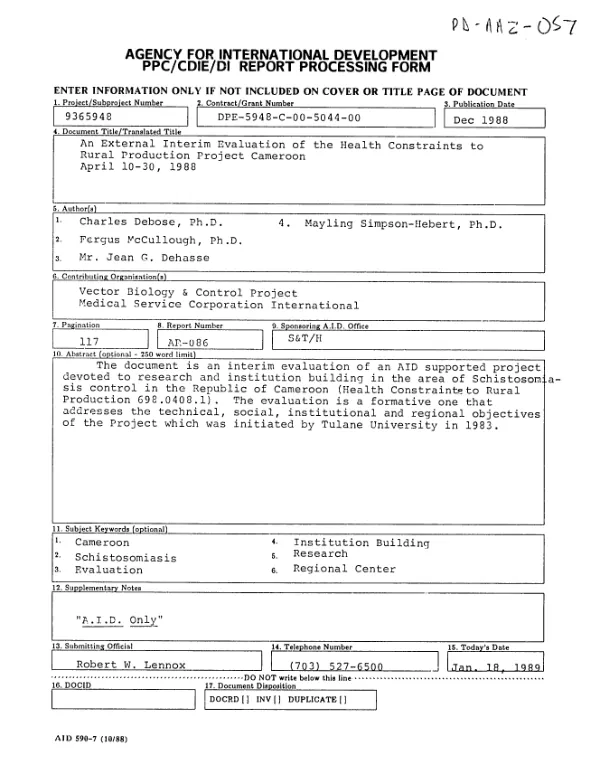
External interim evaluation of the health constraints to rural production project, April 10 - 30, 1988
Sign inMEDICAL SERVICE CORP. INTERNATIONAL
External interim evaluation of the health constraints to rural production project, April 10 - 30, 1988
Evaluates project to strengthen both regional (sub-Saharan African) and Cameroonian capacities to control schistosomiasis by establishing a regional schistosomiasis research facility in Cameroon, conducting studies, and training researchers.
Debose, Charles|McCullough, Fergus · 1988
Sign in to readA free account is required to download.
Abstract
Evaluation was performed 41 months after arrival of the TA team and start-up of the project. The technical studies have been performed very well by the Tulane TA team and the Cameroonian scientists. The mapping of schistosomiasis prevalence and intensity, and the parallel malacological studies have been major achievements and are about 80% complete. The researchers should now consider how their findings can be applied to national schistosomiasis control programs. The socioeconomic research component was not carried out; it should be started as soon as possible in order to contribute to the design of effective control strategies. Lack of implementation of the socioeconomic research component of the project will adversely affect the development of control activities that are economical and socially acceptable to the Cameroonians. The training component has been very successful, about 70% complete, though heavily weighted in favor of Cameroon. Twelve Cameroonian trainees are working toward Ph.D. degrees, while eight non-Cameroonians are being trained at the Master's level. Cameroon's Institute for Medical Research and Medicinal Plants (IMPM) should now give serious consideration to effective assimilation of the returning students into schistosomiasis or allied research programs. Few of the regional objectives of the project have been met. The team also found deficiencies in the institution building objectives of the project, which are only about 10-15% complete. One major problem was that the Project Paper did not give thorough consideration to institution building and its sustainability. Another problem was that none of the three parties - A.I.D., Tulane, or the IMPM - involved in project implementation focused on the institutional objectives. Other major outputs of the project and their levels of completion are (1) construction of a schistosomiasis research center, 25% completed; (2) increased knowledge about schistosomiasis, 85% completed; and (3) formation of interagency and regional network, 10% completed. In sum, many of the components of this project have been very successful, but some deficiencies still remain. Remedial action would include planning a pilot control study, developing work plans, ensuring further training of key personnel, and staging workshops, as recommended below. In the case of socioeconomic research, funds and personnel will need to be identified. The project is now in a position to go beyond its present status by reaching out on a national and regional basis to disseminate results and develop strategies to control schistosomiasis. The project has many aspects of which the Government of Cameroon can be proud. Sustaining the effort in the years ahead is a major challenge. (Author abstract)
Related documents