BIDDLE ASSOCIATES
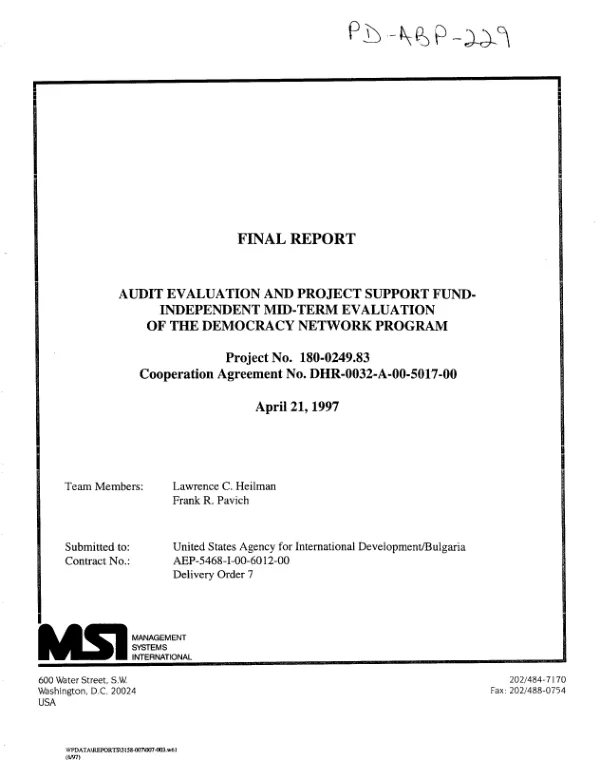
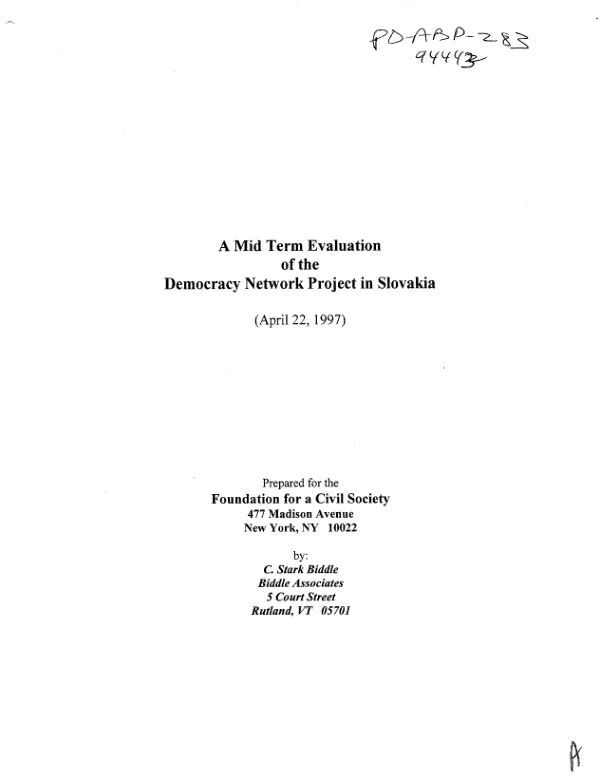
Mid-term evaluation of the democracy network project in Slovakia
Evaluates the Slovakia component of a project to solidify the long-term prospects for democracy in Central and Eastern Europe by strengthening indigenous public policy-oriented NGOs.
Biddle, C. Stark · 1997
Sign in to readA free account is required to download.
Abstract
Interim evaluation covers the period 3/95-3/97. The project is being implemented by the Foundation for a Civil Society. Implementation challenges have included clarifying the concept of "public policy" in a way that is pragmatically meaningful to Slovakia, whether to focus on core support or on projects, whether to offer support to a limited group of organizations or the NGO sector as a whole, whether to pursue a large grant policy to a few organizations or a small grant policy to many, the balance between Bratislava- and rural-based NGOs, the structure of the program cycle, and the operation of the Democracy Commission. Despite a weak donor base, a poor understanding of fundraising techniques, a lack of public advocacy skills, and a deficient legal and regulatory framework, Slovakia's NGO sector is generally dynamic and energetic, shows strong leadership and an impressive amount of associational activity, and has a growing sense of identity and an increasing appreciation of the potential role of the independent sector. Yet there are significant institutional deficiencies, including a thin executive structure, lack of middle management, limited analytical capacity, and dependence on foreign donors. With respect to specific organizational needs, Slovakian NGOs could benefit from a better understanding of the role and management of boards of directors, skills in financial modeling and strategy, and a stronger capacity to do strategic planning. Indigenous private sector support for the NGO sector is very limited and only beginning to emerge. However, there is no reason to conclude that habits of philanthropy are fundamentally at odds with Slovak culture and values. The prospective level of future giving from local private sources will be a function of national economic growth and will reflect the learned capacity of the NGO sector to locate, cultivate, and access charitable support from corporations, individuals, and foundations. While corporate giving can be important, long-run support is likely to come from individual donors. With regard to impact, the project's approach to the concept of public policy is appropriate given the condition of the NGO sector. Also, the project has led to a broadened understanding of the importance of advocacy and public policy, a deeper appreciation of the relevance of policy to program goals, and a shift in emphasis within the NGO sector toward an emphasis on public policy. Individual grants demonstrate a link to systemic change, a positive impact on citizen participation, and show success in reaching into rural areas. The subgrants appear to be well-timed, and the rigorous and professional selection process has had a very positive result. While there are pros and cons to a large grant strategy, it is critically important to provide management assistance. A significant number of grantees have not formulated practical and realistic program plans and financial strategies to address the fall-off in funding once the project terminates. Project gains are at risk unless considerable attention is devoted to helping recipients strengthen their organizational capacity and solidify their base of support. The key recommendation is that the project concentrate on institutional strengthening during balance of its life and work with a limited number of organizations that have already received a subgrants. Other recommendations are: not to proceed with Round V; make existing subgrantees eligible for a follow-on grant; design an exit strategy and a program of organizational strengthening; place particular emphasis on the formulation of financial strategies; restructure and re-focus the training and TA program; terminate the voucher and mentor program; and consider a project extension if it can be demonstrated that a modest extension can improve subgrantee sustainability. An attachment to the report discusses several conceptual problems connected with the term "sustainability". (Author abstract)