USAID DEC
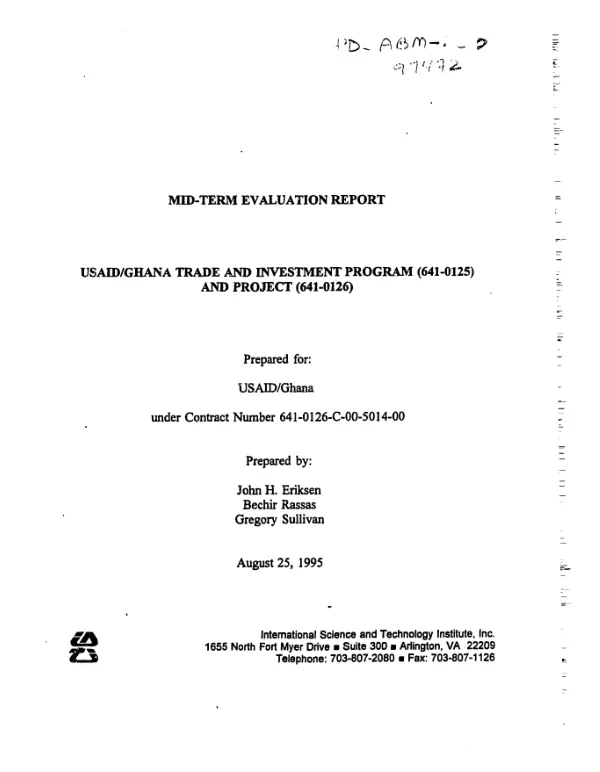
Mid-term evaluation report : USAID/Ghana trade and investment program (641-0125) and project (641-0126)
Sign inINTERNATIONAL SCIENCE AND TECHNOLOGY INSTITUTE, INC. (ISTI)
Mid-term evaluation report : USAID/Ghana trade and investment program (641-0125) and project (641-0126)
Evaluates Trade and Investment Program (TIP) in Ghana to increase private sector nontraditional exports (NTEs) through project and nonproject assistance.
Eriksen, John H.|Rassas, Bechir|Sullivan, Gregory · 1995
Sign in to readA free account is required to download.
Abstract
Mid-term evaluation covers the period 9/92-8/95. Achievements have been notable. A number of TA models were tested and have allowed TIP to reach a broad spectrum of existing and potential exporters with well-tailored interventions in a remarkably short period. These interventions have created a number of pilot activities, some of which appear ready for rapid growth and expansion; it is expected that these pioneering firms will set examples for others to follow. Additionally, TIPS has strengthened linkages to the global market for timely market and price information, improved market facilities and product handling capability, and increased foreign buyers' knowledge of Ghanaian NTE products. TIP contractors and grantees have helped firms to increase product availability, improve quality and productivity, and improve sourcing of materials, equipment, and services. TIP has also been instrumental in establishing four new trade and professional private sector entities that provide advocacy, management and technical training, market information, and marketing services. TIP activities have had a positive impact on the local economy in terms of employment and increased income; this conclusion runs counter to the perception that a small number of advantaged firms have monopolized TIP assistance. Considerable progress has also been achieved in broadening the dialogue between the public and private sectors. A well- defined action plan to improve the policy framework governing NTEs and reduce regulatory and administrative transaction costs has been implemented. Enactment of the Export and Import law has improved NTE regulations well beyond the original TIP design. TIP has generally been less successful in alleviating commercial financial constraints on emerging export firms. Such constraints should not be overstated, however (particularly in relation to the many other infrastructural and technological constraints), given the fact that many NTE companies are expanding export sales -- some at rates of 50% to 100%. Given the number of institutions involved in TIP and the range of its activities, it is remarkable that the program has progressed without major difficulties. Nevertheless, interviews with TIP participants indicate that further improvements can be achieved through better communication and coordination.
Related documents
Documents in this collection
 1994
1994USAID DEC
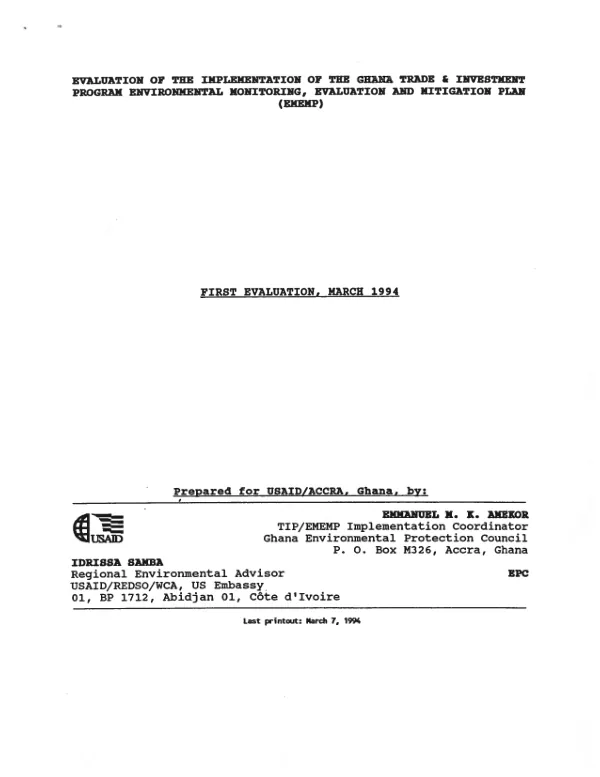
Evaluation of the implementation of the Ghana trade & investment program environmental monitoring, evaluation and mitigation plan (EMEMP) : first evaluation, March 1994
Open record 1993
1993USAID DEC