USAID DEC
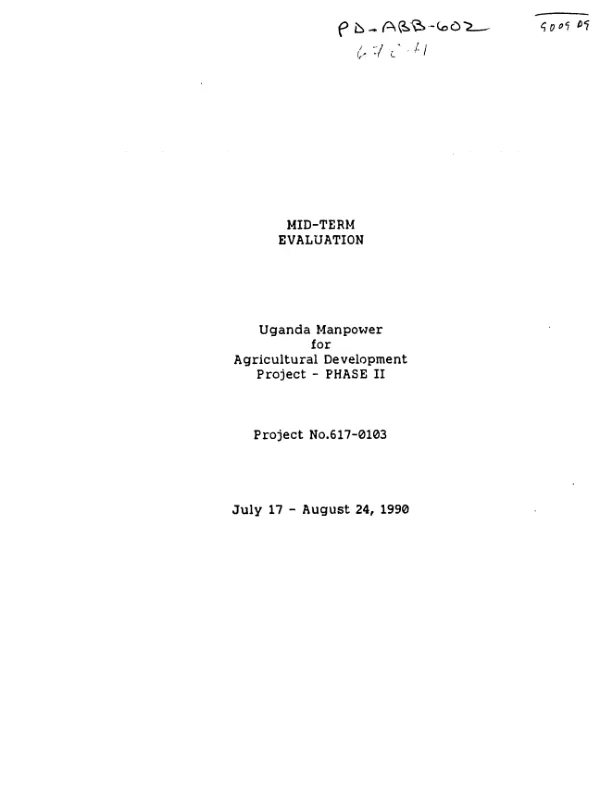
Mid-term evaluation : Uganda manpower for agricultural development project - phase II
Sign inUSAID. MISSION TO UGANDA
Mid-term evaluation : Uganda manpower for agricultural development project - phase II
Mid-term evaluation of a project to rehabilitate and refocus Uganda's food crop production capability in the direction of small farmer production.
Ayling, Robert I.|Osaban, A. K. · 1990
Sign in to readA free account is required to download.
Abstract
The evaluation covers the period 8/83- 8/90. Progress has been substantial. Ministry of Agriculture (MOA) research centers at Kawanda and Namulonge have been rehabilitated almost completely, and progress has been made in transferring on- station research findings to extensionists and farmers and in involving these two groups in on-farm trials. As a result, farmers are adopting technology packages of improved varieties and agricultural practices. Specific research accomplishments include: (1) two studies on food crop research planning and prioritization and three research plans dealing with commodities (sorghum, maize, and sunflowers); (2) testing of a large number of germplasm materials resulting in 11 food crop varieties being released to farmers and 11 pending release; and (3) the release of new varieties of soybeans, sunflowers, potatoes, and beans. The project has also contributed to the institutional strengthening of the MOA and the Makerere University Faculty of Agriculture and Forestry (MU/FAF). Members of both institutions are being trained in the numbers and disciplines necessary to develop a critical mass of scientists. The MOA has established six commodity teams and accomplished a good deal in food crop commodity research planning and prioritization. MU/FAF has instituted two additional departments (Agricultural Engineering and Food Science and Technology) and adjusted its curriculum to the agriculture sector's evolving demands. The rehabilitation of its teaching/research station at Kabanyolo should be completed by 12/90. Areas of concern include the need to tighten up and streamline project management and to provide for the sustainability of the institutions being assisted by initiating negotiations among the MOA, MU/FAF, and USAID/U regarding the inclusion of operating costs of faculty and research into the government budget process. Three major lessons were learned. (1) The development of new technology through commodity teams or the scientist critical mass approach is possible with a reasonable number of local scientists. (2) Project designs that promote collaboration between the MOA and MU/FAF are more effective and efficient than those which focus on either institution separately. (3) On-farm trials are extremely helpful in transferring technology and new seed varieties to farmers and in gaining farmer feedback.