USAID DEC
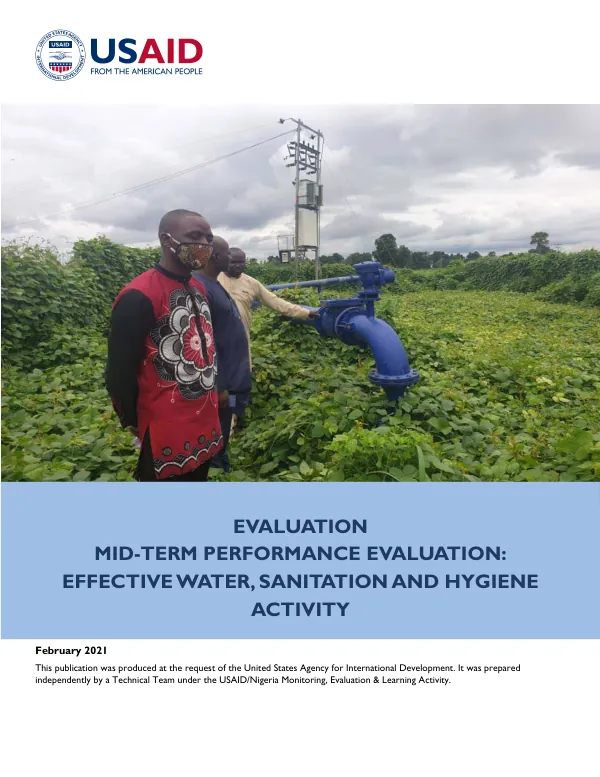
Mid-Term Performance Evaluation of the Effective Water, Sanitation and Hygiene Activity
Sign inDEVTECH SYSTEMS, INC.
Mid-Term Performance Evaluation of the Effective Water, Sanitation and Hygiene Activity
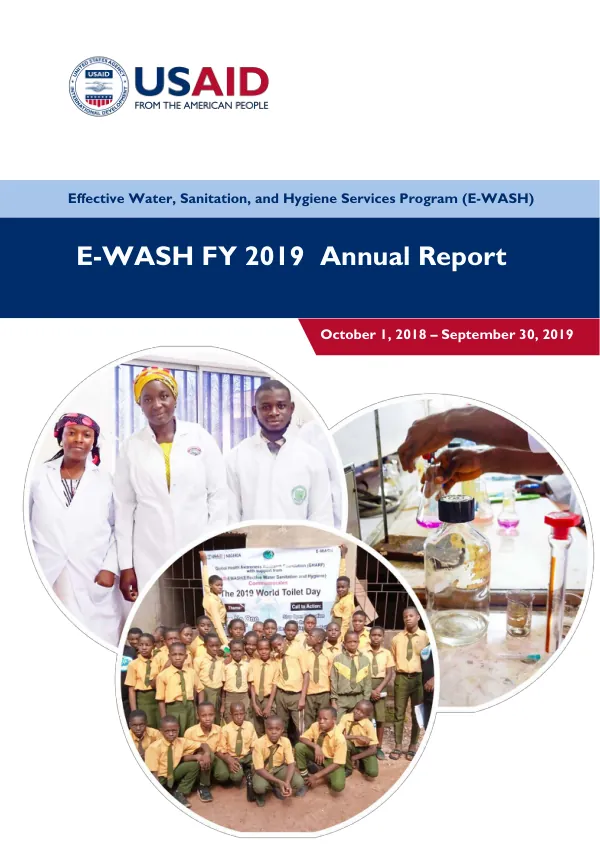
The Effective Water, Sanitation, and Hygiene (E-WASH) Activity in Nigeria was designed to address the worsening performance indices of urban water supply in the country.
2021 · 167 pages
Sign in to readA free account is required to download.
Abstract
The Nigeria Mission of the United States Agency for International Development (USAID) awarded a four-year contract to the Research Triangle Institute (RTI) to implement the Program. E-WASH commenced in May 2018 and will end in February 2022. The E-WASH Program aimed to assist the Government of Nigeria (GON) in implementing a strategy to address the challenges of rapid population growth, rapid urbanization, institutional governance constraints, and poor cost recovery. The Program focused on building state level capacity to improve sustainable service delivery, strengthening local governance and management, strengthening Monitoring, Evaluation, and Learning, and advancing Policy Reforms. The Evaluation Team conducted extensive desk research, including reviewing E-WASH project documents, and conducted key informant interviews with stakeholders, including USAID staff, E-WASH implementing partner staff, and 212 stakeholder respondents in the states participating in E-WASH. The team also conducted field visits to utility assets in each of the states. The findings of the evaluation revealed that the implementation strategy of the E-WASH Activity is appropriate for a multifaceted Activity of this nature. There are positive results to support this assertion, including progress in legal, administrative, and management reforms that form the base for physical improvements in service delivery. The building blocks for progress have been laid, although physical expansion and improvements of access to water services have been minimal when assessed at this mid-term stage of the program cycle. The Evaluation Team also found that there is a general and gradual change in attitude towards public property and an appreciation that water does have value, as do the assets that make clean water available. This first crucial step in state level capacity building on which all others rest has been achieved by the E-WASH Activity. The Evaluation Team conducted an analysis of the KII responses, utility assessments, and desk review to answer the formal evaluation questions from the USAID Statement of Work. The findings, conclusions, and recommendations are organized by evaluation question. Each section is presented with findings that answer the primary and secondary evaluation questions. The Evaluation Team concluded that the E-WASH Activity has been successful in building state level capacity to improve sustainable service delivery, strengthening local governance and management, strengthening Monitoring, Evaluation, and Learning, and advancing Policy Reforms. The Activity has laid the building blocks for progress, and the general and gradual change in attitude towards public property and an appreciation that water does have value are crucial steps in state level capacity building. The Evaluation Team recommended that the E-WASH Activity continue to build on the progress made so far and focus on implementing the remaining components of the Program. The Activity should also continue to engage with stakeholders and build on the general and gradual change in attitude towards public property and an appreciation that water does have value. The Evaluation Team also recommended that the E-WASH Activity should focus on strengthening local governance and management, strengthening Monitoring, Evaluation, and Learning, and advancing Policy Reforms. The Activity should also continue to engage with stakeholders and build on the progress made so far. The Evaluation Team concluded that the E-WASH Activity has been successful in achieving its goals and objectives, and the recommendations provided will help the Activity to continue to build on the progress made so far and achieve its remaining goals and objectives.