USAID DEC
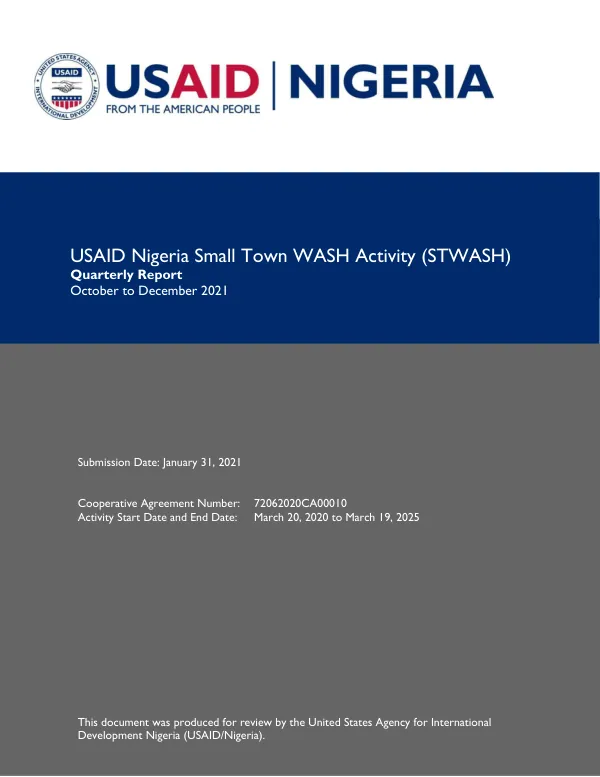
USAID Nigeria Small Town WASH Activity (STWASH) Quarterly Report October to December 2021
Sign inMERCY CORPS INTERNATIONAL
USAID Nigeria Small Town WASH Activity (STWASH) Quarterly Report October to December 2021
The USAID Nigeria Small Town WASH Activity (STWASH) is a five-year initiative aimed at facilitating the economic recovery of crisis-affected communities in Adamawa, Yobe, and Borno states in North-East Nigeria.
2021 · 28 pages
Sign in to readA free account is required to download.
Abstract
The program, funded by the United States Agency for International Development (USAID), has a budget of $8 million and seeks to bolster the capacities of local institutions to provide sustainable water, sanitation, and hygiene (WASH) services. The STWASH program has two broad components: Expanded access to water and sanitation facilities, and Strengthening capacity for small-town water governance and management. The program's four clear outcomes are designed to achieve the project goal and prove the theory of change, which states that local institutions providing safe, reliable, affordable, equitable, and appropriate WASH infrastructure and services will increase access to sustainable WASH services, contributing to reduced tensions between crisis-affected communities, improved health and security, particularly for women, girls, the most vulnerable, and inhabitants of small towns. The program has made significant progress in the reporting period, with several water and sanitation projects completed in FY22 Q1. However, to count these projects against the indicators, they must be fully handed over to the beneficiaries, with a concrete operational structure in place to run them. As of the end of the reporting period, 8,500 people had gained access to basic drinking water services, and 9,890 people had gained access to basic sanitation services. Additionally, 2 institutional settings had gained access to basic drinking water services, and 8 basic sanitation facilities had been provided in institutional settings. The program has also made progress in strengthening capacity for small-town water governance and management. In Q1 FY22, Adamawa used an existing manual to re-train Volunteer Hygiene Promoters (VHPs) and School Hygiene Clubs (SHCs) in each small town. Although a similar training happened in Yobe last quarter, WaterAid supports developing a generic modular training manual for VHPs and SHCs in small towns to effectively manage the systems. In Borno, VHPs have been formed, and the trained VHPs will start collecting reports against the second quarter. The program has also engaged with civil society organizations (CSOs) and media to support implementation and coordinate ongoing efforts to increase demand for improved WASH provision. In Q4 FY21, STWASH reported selecting 3 CSOs in each state to support implementation and coordinate ongoing efforts to increase demand for improved WASH provision. In Q1 FY22, WaterAid made a formal presentation to Mercy Corps to engage the selected CSOs and onboard them. The CSOs will commence operations as soon as Mercy Corps approves the request. The program has also made progress in promoting access to improved water through policies, laws, agreements, regulations, or investment agreements. Since inception, STWASH has completed 7 documents: 3 MOUs, 2 WASH policies, and 2 M&E Frameworks. The program has also made progress in engaging with the media to promote WASH-related behavior change interventions. In Q1 FY22, Adamawa used an existing manual to re-train VHPs and SHCs in each small town, and in Borno, VHPs have been formed.
Related documents