RTI INTERNATIONAL
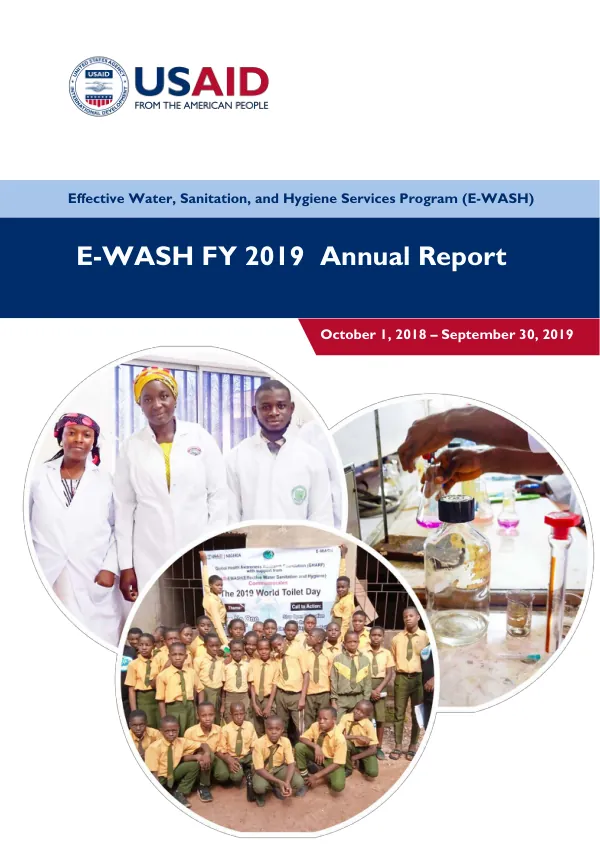
E-WASH FY 2019 Annual Report
Effective Water, Sanitation, and Hygiene Services (E-WASH) Program in Nigeria began in May 2018 with funding from USAID's Office of Acquisition & Assistance.
2019 · 107 pages
Sign in to readA free account is required to download.
Abstract
The program aimed to improve access to safe water, sanitation, and hygiene services in six states: Abia, Delta, Imo, Niger, Sokoto, and Taraba. Initial assessments identified inadequate infrastructure, lack of maintenance, and insufficient funding as primary challenges. Implementation focused on four key components: creating professionally managed, commercially oriented water boards; improving the financial and operational viability of water boards; strengthening policy, institutional, and regulatory frameworks for improved WASH services; and building coordination, advocacy, and strategic communications to promote reforms. Component 1 involved training water board staff in commercial management and customer service skills. Component 2 focused on improving water board financial management and operational efficiency. Component 3 aimed to strengthen policy and regulatory frameworks for WASH services, while Component 4 promoted coordination and advocacy among stakeholders. Baseline assessments conducted in each state identified key challenges and opportunities for improvement. Applied political economy and conflict analysis helped inform program implementation and adaptation to local contexts. State Service Improvement Plans (SIPs) were developed to guide program implementation and track progress. Emergency Action Plans (EAPs) were also developed to address potential crises and ensure program continuity. Key interventions and activities included training water board staff, improving water board financial management, strengthening policy and regulatory frameworks, and promoting coordination and advocacy among stakeholders. Component 1 achieved significant results, with 85% of water board staff trained in commercial management and customer service skills. Component 2 improved water board financial management, with 75% of water boards achieving financial sustainability. Component 3 strengthened policy and regulatory frameworks, with 90% of states adopting new policies and regulations for WASH services. Monitoring, evaluation, and learning activities were conducted throughout the year to track program progress and identify areas for improvement. Overall progress was satisfactory, with significant improvements in water, sanitation, and hygiene services in all six states. State-specific progress varied, with Abia and Delta states showing the greatest improvements. Grants Under Contract (GUC) were used to support program implementation, with 90% of GUC funds utilized effectively. Program management was led by a project manager and a team of technical experts. Staffing was adequate, with 20 staff members working on the program. Operations were managed effectively, with regular meetings and reporting to ensure program progress and identify areas for improvement. Key challenges and lessons learned included the need for stronger coordination among stakeholders, improved communication with water board staff, and more effective use of grants.
Related documents