CHEMONICS
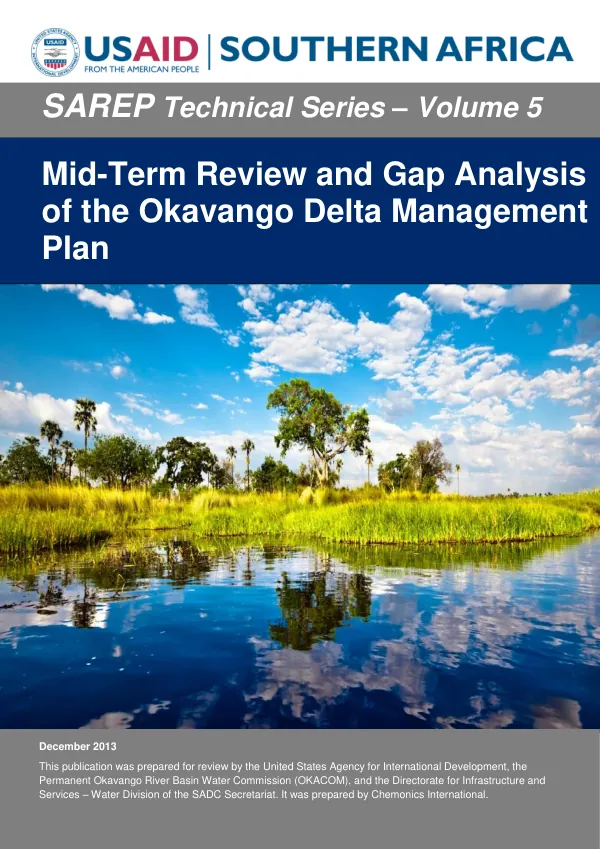
Mid-Term Review and Gap Analysis of the Okavango Delta Management Plan
The Okavango Delta Management Plan (ODMP) is an integrated plan that serves as an overarching planning framework for the sustainable use, conservation, and management of the resources of the Okavango Delta Ramsar Site.
2013 · 161 pages
Sign in to readA free account is required to download.
Abstract
The plan was approved in 2008 and has as its overall goal: "To integrate resource management for the Okavango Delta that will ensure its long-term conservation and that will provide benefits for the present and future well-being of the people through sustainable use of its natural resources." The ODMP is a comprehensive plan that blends 12 contributing components, including biodiversity, hydrology, tourism, agriculture, and socioeconomic development. The plan aims to balance conservation and socioeconomic development goals, and its implementation is guided by a management-oriented implementation strategy. The ODMP Coordination Unit was set up in Maun to oversee the implementation of the plan, and key advisors were placed within the unit to interact with line ministries, the private sector, resource users, and communities to define the ODMP strategy. The ODMP was the first of its kind developed for Botswana wetlands following the Ramsar Convention Guidelines. However, the plan failed to document a clear, pragmatic approach to replicate the ODMP in other wetland systems in Botswana and the region. Sustainability was supported by integrating implementation costs within sector budgets in government and securing long-term commitments from the private sector. However, beyond these actions, no sustainability plan was formulated for the project, and stakeholders agreed that the ODMP paid little attention to regional, sustainability-related issues of population growth and overall economic development. The ODMP mid-term review assessed the overall performance of the plan with regard to its stated objectives, set targets, and expected outcomes. The review included a monitoring framework with well-defined indicators and recommendations to ensure effective and efficient plan implementation. The review process comprised a four-stage process that drew heavily on stakeholder inputs throughout, including stakeholder workshops organized into thematic areas. The review identified several key findings, including the need for a clear, pragmatic approach to replicate the ODMP in other wetland systems in Botswana and the region. The review also highlighted the importance of integrating implementation costs within sector budgets in government and securing long-term commitments from the private sector. Additionally, the review emphasized the need for the ODMP to pay more attention to regional, sustainability-related issues of population growth and overall economic development. The ODMP implementation approach was initially project-based, with the ODMP Coordination Unit working with sector line ministries during formulation of the plan. However, stakeholders considered this approach effective, as they noted that projects embedded in government bodies often function poorly. The review recommended a more integrated approach to implementation, with a focus on sustainability and regional, sustainability-related issues. The ODMP has made significant progress in several areas, including biodiversity conservation, hydrology management, and tourism development. However, the plan has also faced several challenges, including limited resources, inadequate infrastructure, and lack of community participation. The review recommended several measures to address these challenges, including the development of a clear, pragmatic approach to replicate the ODMP in other wetland systems in Botswana and the region. Overall, the ODMP mid-term review has provided valuable insights into the strengths and weaknesses of the plan and has identified several key areas for improvement. The review has emphasized the importance of sustainability, regional, sustainability-related issues, and community participation in the implementation of the ODMP.
Related documents