USAID DEC
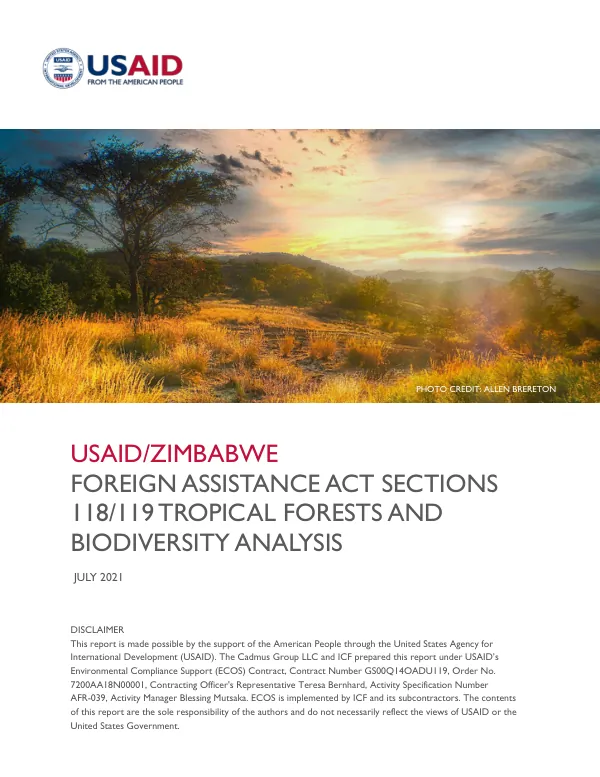
USAID | Zimbabwe Foreign Assistance Act Sections 118/119 Tropical Forests and Biodiversity Analysis
Sign inICF
USAID | Zimbabwe Foreign Assistance Act Sections 118/119 Tropical Forests and Biodiversity Analysis
The USAID/Zimbabwe Foreign Assistance Act Sections 118/119 Tropical Forests and Biodiversity Analysis was prepared by ICF and The Cadmus Group LLC in July 2021.
2021 · 109 pages
Sign in to readA free account is required to download.
Abstract
The analysis team consisted of Paola Bernazzani, Jaime Capron, Jesse Gibson, Josh Habib, Edward Mufandaedza, Victor Muposhi, and Alexis Weaver, with contributors Jon Hecht, Molly Hellmuth, and Jodi O'Grady. The report provides an overview of the status of tropical forests and biodiversity in Zimbabwe, highlighting major ecosystem types and their status, species diversity and status, genetic diversity, and the management of protected areas and key natural resources outside of protected areas. The report also examines the legal framework affecting conservation in Zimbabwe, including national laws, policies, and strategies, international agreements, government agencies, and conservation initiatives. The analysis identifies direct threats to biodiversity in Zimbabwe, including habitat loss and fragmentation, overexploitation of resources, invasive species, climate change, and human-wildlife conflict. The report also identifies drivers of these threats, including population growth, poverty, and lack of access to education and economic opportunities. The report provides recommendations for actions necessary to conserve and protect tropical forests and biodiversity in Zimbabwe, including the establishment of protected areas, sustainable forest management, and the promotion of eco-tourism. The report also recommends the development of a national biodiversity strategy and action plan, as well as the strengthening of laws and policies governing biodiversity and forest resource management. The report concludes that the actions proposed for support by the Agency meet the actions necessary to conserve and protect tropical forests and biodiversity in Zimbabwe. The report provides a list of high-priority recommendations, including the establishment of a national biodiversity strategy and action plan, the development of a sustainable forest management plan, and the promotion of eco-tourism. The report also provides a list of tables, including Table ES 1, which highlights high-priority recommendations, and Table 6, which provides a summary of actions necessary, drivers addressed, and linked threats according to tier of priority. The report also includes annexes, including references, additional tables, and the scope of work. The report provides a comprehensive analysis of the status of tropical forests and biodiversity in Zimbabwe, highlighting the major ecosystem types and their status, species diversity and status, genetic diversity, and the management of protected areas and key natural resources outside of protected areas. The report also identifies direct threats to biodiversity in Zimbabwe and provides recommendations for actions necessary to conserve and protect tropical forests and biodiversity in Zimbabwe.