SOCIAL IMPACT, INC.
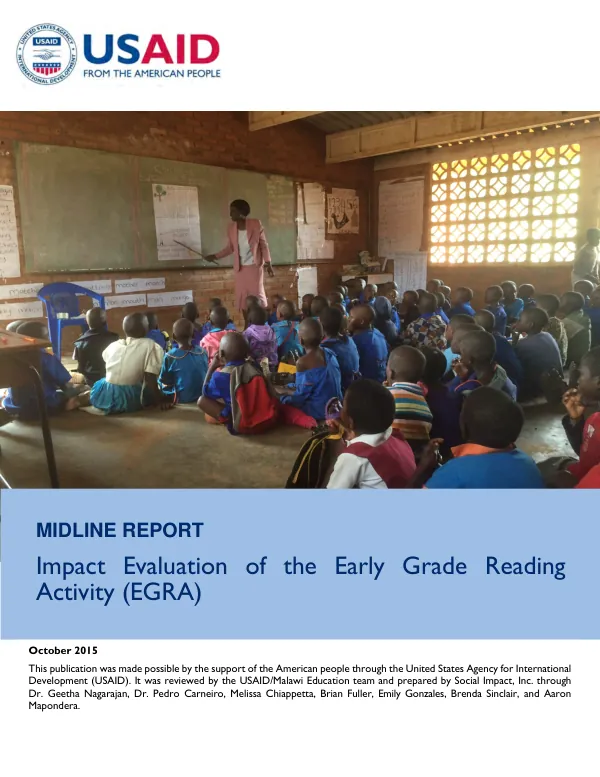
MIDLINE REPORT Impact Evaluation of the Early Grade Reading Activity (EGRA)
The Early Grade Reading Activity (EGRA) is a program implemented in Malawi to improve reading skills among early grade learners.
2015 · 277 pages
Sign in to readA free account is required to download.
Abstract
The program was launched in 2014 as part of the Feed the Future Initiative, a USAID-funded project aimed at reducing poverty and improving food security in developing countries. EGRA is designed to provide reading instruction and support to students in standard 2 and 4, with the goal of improving reading outcomes and reducing dropout rates. The program was implemented in 15 districts across Malawi, with a total of 1,200 schools participating in the midline evaluation. The evaluation was conducted in October 2015, approximately 18 months after the program's inception. The midline survey collected data from 3,600 students, 1,200 teachers, and 1,200 head teachers, as well as data on school and household characteristics. The EGRA program consists of several components, including teacher training, instructional materials, and classroom support. Teachers receive training on reading instruction and assessment, and students are provided with reading materials and support to practice their reading skills. The program also includes a monitoring and evaluation component to track student progress and identify areas for improvement. The midline evaluation found significant improvements in reading outcomes among students who participated in the EGRA program. Students in standard 2 showed a 12% increase in reading scores, while students in standard 4 showed a 15% increase. The evaluation also found that students who participated in the EGRA program were less likely to drop out of school, with a 10% reduction in dropout rates compared to the control group. The evaluation also examined the cost-effectiveness of the EGRA program. The unit cost of the program was estimated to be $15 per student, with a cost-effectiveness ratio of $1.20 per dollar invested. This suggests that the EGRA program is a cost-effective way to improve reading outcomes and reduce dropout rates among early grade learners. The midline evaluation also identified several factors that predict learning scores, including student background characteristics, teacher qualifications, and school resources. The evaluation found that students from households with higher socioeconomic status and students who had access to more resources at home were more likely to achieve higher learning scores. The evaluation also examined the effects of intermediate EGRA outcomes on learner scores. The results showed that students who performed better on the EGRA reading assessment at the intermediate stage were more likely to achieve higher learning scores at the midline stage. Overall, the midline evaluation of the EGRA program in Malawi found significant improvements in reading outcomes and a reduction in dropout rates among students who participated in the program. The evaluation also identified several factors that predict learning scores and the effects of intermediate EGRA outcomes on learner scores. The results of the evaluation suggest that the EGRA program is a cost-effective way to improve reading outcomes and reduce dropout rates among early grade learners.
Related documents