AVSI FOUNDATION
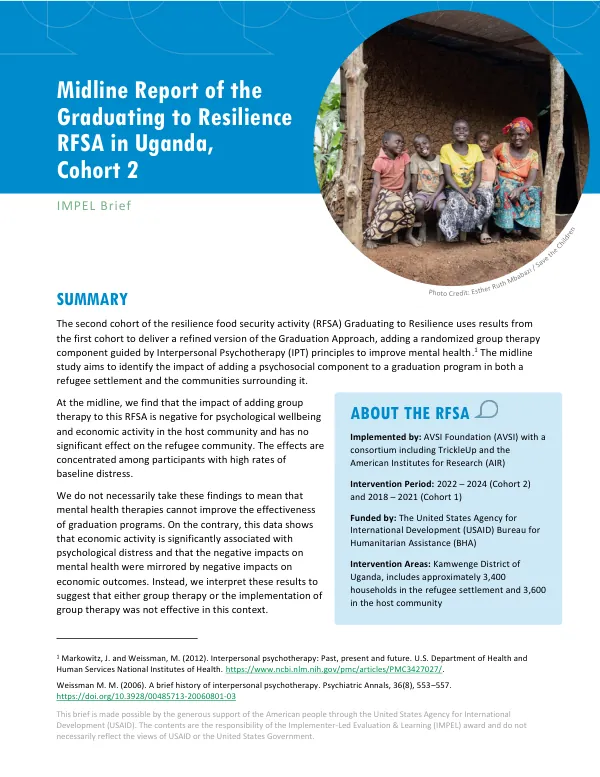
Midline Report of the Graduating to Resilience RFSA in Uganda, Cohort 2
The Graduating to Resilience Resilience Food Security Activity (RFSA) in Uganda began in 2018 with funding from the United States Agency for International Development (USAID) Bureau for Humanitarian Assistance (BHA).
2023 · 5 pages
Sign in to readA free account is required to download.
Abstract
The activity aims to improve mental health and self-reliance among extremely poor households in the Rwamwanja Refugee Settlement and the surrounding host communities. The Implementer-Led Evaluation and Learning (IMPEL) Associate Award conducted a randomized evaluation of Cohort 1 to better understand the effectiveness of several variants of graduation programming focused on improving nutrition and self-reliance among populations in and around a refugee settlement. The evaluation found that the adjusted graduation programming had significant positive impacts for both activity participants and their households on key outcomes, including food security, nutrition, and self-reliance. All variations of the graduation programming also had large positive returns on investment. Building on the success of Cohort 1, Cohort 2 of the Graduating to Resilience RFSA includes 7,000 households in western Uganda and consists of both a round of follow-up surveying of Cohort 1 study participants to measure longer-term impacts as well as an evaluation designed specifically around Cohort 2 interventions. The latter aims to provide new evidence on amplifying the impact of the "Refined Graduation" Approach by incorporating low-cost mental health treatments, namely group therapy guided by Interpersonal Psychotherapy (IPT) principles. This document refers to the approach of this second cohort as "Refined Graduation" to distinguish the package of interventions administered in Cohort 2 from those of Cohort 1. The key interventions of the Refined Graduation Approach are consumption support, productive asset transfer, trainings in technical skills, coaching on various themes, access to savings, and referrals and linkages. A midline follow-up survey was conducted to evaluate the group therapy component of Cohort 2. Researchers worked with IPA, AVSI Uganda, USAID, and Save the Children to conduct a randomized evaluation to compare the impact that graduation programming variations (including the addition of group therapy components) have on the psychological wellbeing, health, and economic activity of refugees and host communities. The results of the midline study indicate that the impact of adding group therapy to the RFSA is negative for psychological wellbeing and economic activity in the host community and has no significant effect on the refugee community. The effects are concentrated among participants with high rates of baseline distress. The data suggests that economic activity is significantly associated with psychological distress, and that the negative impacts on mental health were mirrored by negative impacts on economic outcomes. Instead of concluding that mental health therapies cannot improve the effectiveness of graduation programs, the findings suggest that either group therapy or the implementation of group therapy was not effective in this context.