USAID. MISSION TO HONDURAS
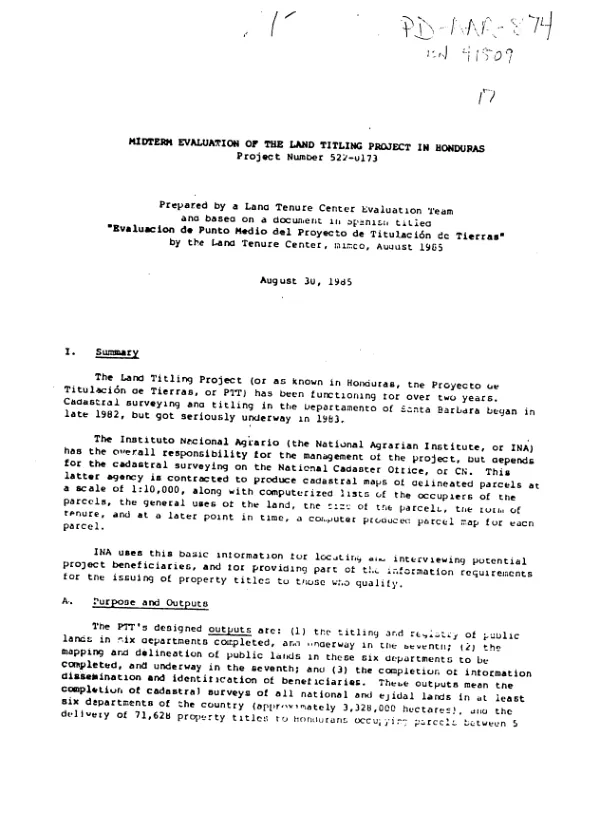
Midterm evaluation of the land titling project in Honduras
Evaluates project to establish a system for titling rural lands in Honduras.
1985
Sign in to readA free account is required to download.
Abstract
Mid-term evaluation covers the period 1982-8/85 and is based on document review, site visits, and interviews with project officials and beneficiaries. After a slow start, the pace and quality of work improved in 1984. The project has delivered more than the planned number of delineated parcels and nearly the planned number of titles in Santa Barbara, but has issued very few titles in Comayagua, where small parcels predominate and less coffee is grown. (By law, such small parcels are eligible for titling only if coffee is grown on them.) The low rate of titling in Comayagua may be partly due to the lack of an effective public relations and information campaign; the Santa Barbara model of direct communication between promoters and farmers is preferable to the Comayagua method of relying on media advertising and cadastral teams. In general, as a methodology for delivering titles, the project has achieved significant results. However, many of the titles issued, especially in Santa Barbara, lack reference to the cadastral map and cadastral identification number and are not precisely tied to a geographic grid. been experienced in differentiating rural and urban parcels (the latter are not addressed by the project) and in setting administrative boundaries between Departamentos and Municipios. The project"s complicated management command structure, in which the National Agrarian Institute (INA) - which is responsible for project management - depends for cadastral surveying on the National Cadaster Office (CN) has led to misunderstandings and delays in the titling process. Also, the project has been criticized for "institutionalizing minifundia" through the issuance of property titles to small holdings. Although farmers generally value the INA titles, they object to paying for land they have considered theirs for years. A further problem is that the low value at which INA assesses the property, while lessening beneficiaries" "debt" to the INA, also serves to reduce its value as collateral for bank loans (access to which, despite the project"s promotional claims, is not guaranteed by the title). Finally, although the project is making the acquisition of property titles easier and less expensive, it appears that the future costs of keeping titles in the Property Registry up to date may be prohibitively high, presenting risk that the lands may pass again into an untitled state.
Related documents