USAID DEC
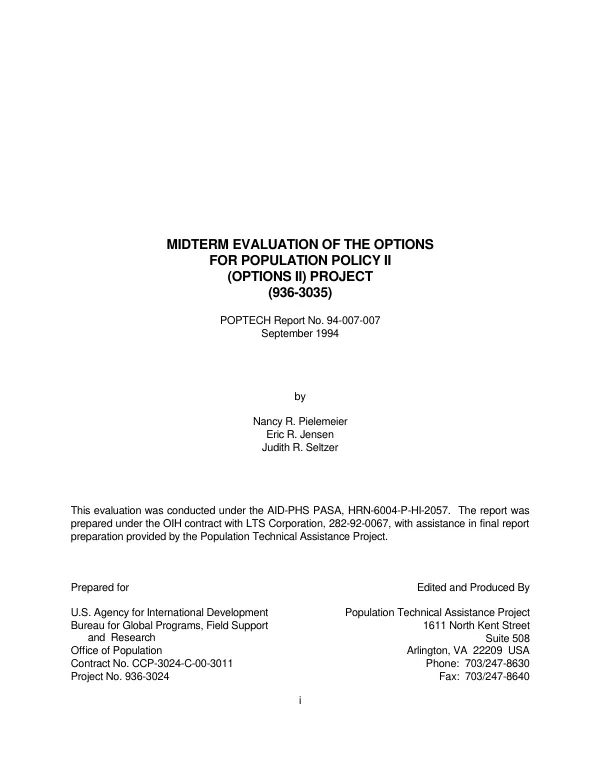
Midterm evaluation of the options for population policy II (OPTIONS II) project (936-3035)
Sign inBASIC HEALTH MANAGEMENT INTERNATIONAL (BHM)
Midterm evaluation of the options for population policy II (OPTIONS II) project (936-3035)
Mid-term evaluation of the Options for Population Policy (OPTIONS) II project, a 5-year follow-on to the OPTIONS I project.
Pielemeier, Nancy R.|Jensen, Eric R.|Seltzer, Judith R. · 1994
Sign in to readA free account is required to download.
Abstract
OPTIONS is being implemented by The Futures Group and four subcontractors: Population Reference Bureau, Urban Institute, Development Group, Inc., and Carolina Population Center. Evaluation covers the period 9/90-9/94. The project has carried out activities in 21 countries and three regional areas (Central Asian Republics, the Near East, and the Sahel). The strong demand for the project's involvement is evident by the rate of expenditure and the level of buy-ins (75% above what was anticipated). Both USAID Missions and local agencies in developing countries have given high marks to the caliber of OPTIONS staff, the quality of the project's technical analysis, the project's flexibility and responsiveness, and its collaborative style in working with local counterparts. OPTIONS has worked in five mandate areas: (1) building consensus on national population and family planning issues; (2) strategic planning; (3) public sector resource commitment; (4) reforming laws and regulations; and (5) private sector resource commitment. The project's activities are concentrated in two of the five mandate areas -- building consensus and strategic planning -- although activities have been undertaken in all areas. In those countries where project efforts have been intensive and of relatively prolonged duration, there is good or promising evidence of impact. In other cases, either because project activities are fairly recent or relatively modest efforts have been undertaken, impact cannot be assessed. In several countries (Ghana, Guatemala, Indonesia, and Jamaica) there has been a combination of interventions, including those classified as planning, over an extended period of time that has led to apparent impact. There are specific examples of positive effects on public sector budgeting and programs in Morocco, the Philippines, Guatemala, and Jamaica and of likely effect in Egypt. Although OPTIONS' work in reforming laws and regulations has been carried out in few countries, the results in Egypt, Guatemala, and Senegal look very promising. The project's work in stimulating private sector resource commitments has had positive impacts in India, Jamaica, and Peru. In the area of consensus building, OPTIONS has contributed to policy development and implementation in many countries and in the Sahel region (by working with the Center for Applied Research on Population and Development) through assistance in formulating policies and laws, assistance in developing communication strategies and/or carrying out specific dissemination activities, observational travel, and assistance in preparing for the 1994 International Conference on Population and Development. In addition to these efforts, a number of USAID Missions cited specific examples of the important contribution OPTIONS has made to the critical thinking of USAID Mission staff, particularly in the areas of estimating the costs of family planning and strategic planning, as well as in the design of future population assistance (Egypt, Ghana, Guatemala, Jamaica, and Peru). Among the policy analysis tools that have been developed by OPTIONS is a series of five policy papers. Four of these address project mandate areas and serve as a useful introduction to the particular topic. While these papers have been in demand and generally well received, there is little evidence of their use in the field. The work of OPTIONS on models has largely involved elaboration and application of existing models (e.g., target-cost, contraceptive market model, and QUIPUS). Commendably, project staff has used Demographic and Health Survey (DHS) data in numerous settings, although efforts to transfer data analysis skills to local counterparts, including the completion of a data analysis manual, have been has less extensive. OPTIONS has conducted various regional and country-specific training activities. The country training was directed to use of the policy models and DHS data and desk-top publishing. There is some evidence of the effectiveness of training in some policy models and in desk-top publishing. OPTIONS' work in the area of policy communication and information dissemination is related to consensus building activities. The development of policy communication strategies as an integral part of OPTIONS' work has occurred in a few settings, and this more comprehensive approach appears to enhance the impact of the project's assistance. OPTIONS has also sponsored numerous presentations to international leadership groups as well as to USAID Missions, the Office of Population, and other U.S. audiences. The computer-assisted presentations, a hallmark of The Futures Group, are widely considered a strength of both OPTIONS and the Resources for the Awareness of Population Impact on Development (RAPID) project. Long-term advisors have been placed by the project in four countries (Egypt, India, Niger, and Peru) and in all cases these advisors have received the enthusiastic support of the USAID Missions. Two activities of the OPTIONS project, the policy files and the fellows program, which will be shifted to a different policy project in the Office of Population, are considered to have been useful components of the work scope. OPTIONS staff has addressed several policy issues, including sustainability and medical barriers, which are logical extensions of the project's ongoing work. Given the particular relevance for USAID's population assistance of these two topics, OPTIONS' work is or will be making an important contribution. (Author abstract)