USAID DEC
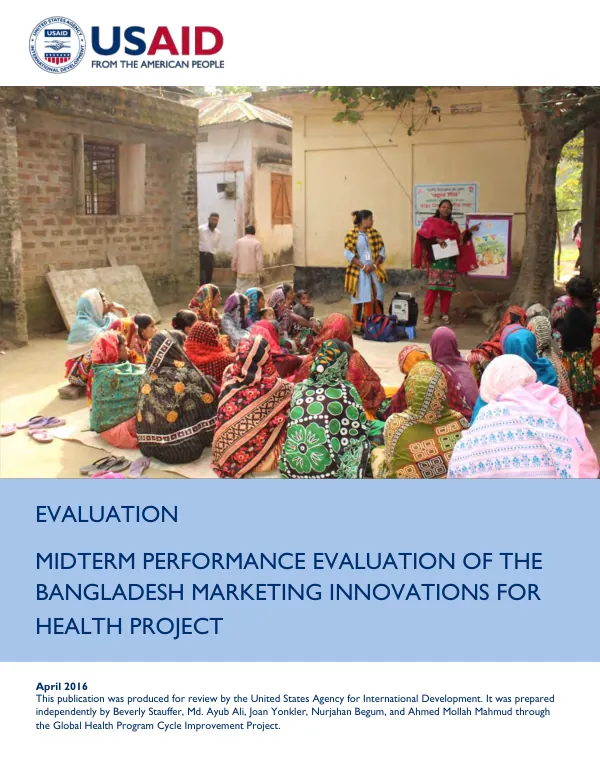
Midterm Performance Evaluation of the Bangladesh Social Marketing Innovations Program Evaluation
Sign inBRAC INTERNATIONAL
Midterm Performance Evaluation of the Bangladesh Social Marketing Innovations Program Evaluation
The Marketing Innovations for Health (MIH) Project in Bangladesh aims to improve the health status of women and children by increasing access to and demand for essential health products and services through the private sector.
2016 · 124 pages
Sign in to readA free account is required to download.
Abstract
The project, led by the Social Marketing Company (SMC) in partnership with various organizations, began in July 2012 and will end in July 2016. The project's goal is to contribute to sustained improvements in the health status of women and children in Bangladesh. The project focuses on increasing access to and demand for essential health products and services through the private sector. To achieve this goal, the project implements various interventions, including social marketing, community-based distribution, and training of community sales agents. The project also aims to improve the quality of health services provided by the private sector through the provision of technical assistance and capacity building. The project's evaluation mechanism is designed to assess the effectiveness of the project's interventions and provide recommendations for future programming. The evaluation team conducted a midterm performance evaluation of the project, which included data collection from various sources, including household tracking surveys, sales data, and interviews with project stakeholders. The evaluation found that the project has made significant progress in increasing access to and demand for essential health products and services. The project's social marketing campaigns have been successful in promoting the use of modern family planning methods, and the community-based distribution system has improved access to these products. The project's training programs for community sales agents have also improved the quality of health services provided by the private sector. The evaluation also found that the project has made significant progress in improving the health status of women and children in Bangladesh. The project's interventions have led to an increase in the use of modern family planning methods, which has resulted in a decline in the total fertility rate and an increase in the contraceptive prevalence rate. The project's social marketing campaigns have also been successful in promoting the use of other essential health products and services, such as oral rehydration salts and vaccines. The evaluation team made several recommendations for future programming, including the need to continue and expand the project's social marketing campaigns, improve the quality of health services provided by the private sector, and increase access to and demand for essential health products and services. The team also recommended that the project continue to work with the private sector to improve the quality of health services and increase access to and demand for essential health products and services. The project's geographic focus is on Bangladesh, with a particular emphasis on the Sylhet Division. The project's timeframes are from July 2012 to July 2016, with a midterm evaluation conducted in April 2016. The project's recommendations are based on the evaluation findings and are intended to inform future programming and decision-making. The project's implementation details include the provision of technical assistance and capacity building to the private sector, the establishment of a community-based distribution system, and the implementation of social marketing campaigns. The project's methodology includes the use of household tracking surveys, sales data, and interviews with project stakeholders to assess the effectiveness of the project's interventions. The project's key findings include the increase in the use of modern family planning methods, the decline in the total fertility rate, and the increase in the contraceptive prevalence rate. The project's conclusions are that the project has made significant progress in improving the health status of women and children in Bangladesh and that the project's interventions have been effective in increasing access to and demand for essential health products and services.