ABT ASSOCIATES
Sources of Family Planning: Bangladesh
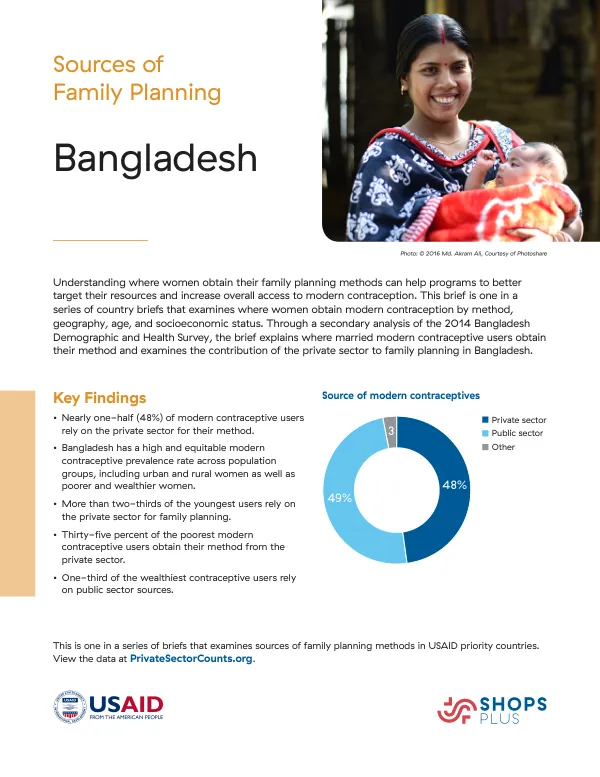
The modern contraceptive prevalence rate in Bangladesh is high and equitable across population groups, including urban and rural women as well as poorer and wealthier women.
2019 · 4 pages
Sign in to readA free account is required to download.
Abstract
Among currently married women of reproductive age, more than half (54 percent) use modern contraception. Short-acting methods (SAMs), primarily pills and injectables, are the most popular methods among married women, responsible for the country's modest modern contraceptive prevalence rate increase. Fewer women use long-acting reversible contraceptives (LARCs) and permanent methods (PMs), which have remained stable at 8 percent. Among all modern contraceptive users in Bangladesh, nearly half rely on the public (49 percent) and private (48 percent) sectors. These source patterns are similar to those reported in 2011. SAM users are slightly more likely to obtain their method from a private than public source, while LARC and PM users are more likely to visit a public than a private facility. Among pill users, Bangladesh's leading method, 55 percent use private sources and 42 percent use public sources. For injectable users, the public sector is a more common source than the private sector (61 percent versus 34 percent, respectively). Among condom users, who constitute 12 percent of all modern method users, the private sector is the primary source (83 percent). The private sector plays a significant role in providing modern contraceptives in Bangladesh, particularly among younger users. Among all private sector users, the majority (84 percent) obtain their method from a pharmacy, drug store, or shop. In addition, 9 percent rely on NGOs and 7 percent on hospitals or clinics. The two methods most commonly sought from the private sector are pills and condoms. Nearly all pill and condom private sector users obtain their contraceptive from a pharmacy or shop (94 percent and 97 percent, respectively). Urban contraceptive users are more likely to purchase their method from the private sector (63 percent) compared with rural users (42 percent). The method mix varies between urban and rural areas, as well. Condoms, the method most commonly sought from the private sector, are more popular among urban users than among rural users (21 percent versus 8 percent, respectively). Injectables, however, are less commonly used in urban areas than in rural areas (17 percent versus 25 percent, respectively). Pills remain the most popular method across urban and rural areas, relied on by approximately half of users. Contraceptive source varies by division, as well. Private sector use is highest in Chittagong (56 percent) and Dhaka (54 percent) and lowest in Rangpur (39 percent). The population in Rangpur, Sylhet, and Khulna is at least two-thirds rural, which helps explain the lower private sector use. Contraceptive users age 15-19 and 20-24 are more likely than users age 25-49 to rely on the private sector (67 and 57 percent versus 44 percent, respectively). The prevalence of condom use does not vary by age. However, users age 15-19 and 20-24 are more likely to rely on pills (64 and 55 percent), which are commonly sought from the private sector, than users older than age 25 (47 percent).
Related documents