USAID DEC
Engaging Volunteer Networks for Family Planning: Connecting Communities with Facilities
Sign inBRAC INTERNATIONAL
Engaging Volunteer Networks for Family Planning: Connecting Communities with Facilities
The Ministry of Health and Family Welfare in Bangladesh recruited 23,500 family welfare assistants (FWAs) between 1978 and 1990 to provide family planning services to households.
2016 · 4 pages
Sign in to readA free account is required to download.
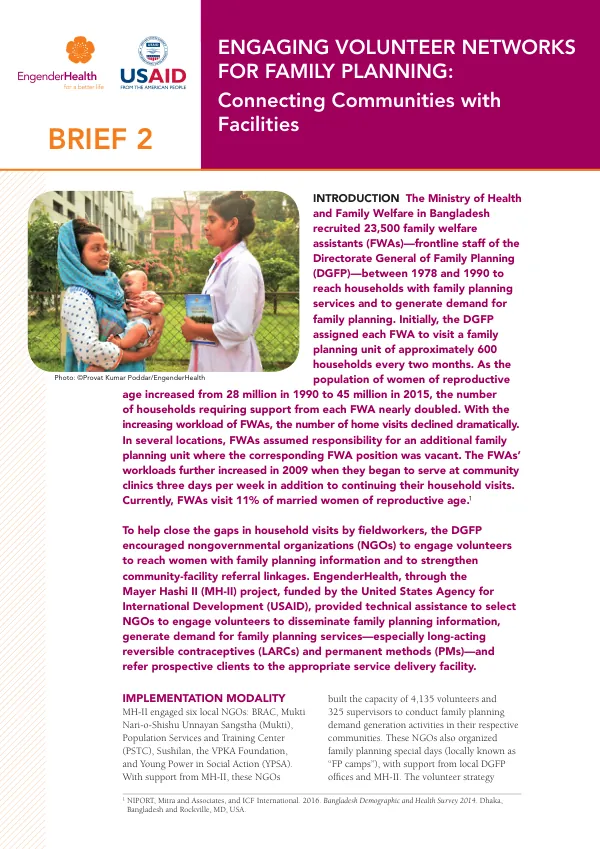
Abstract
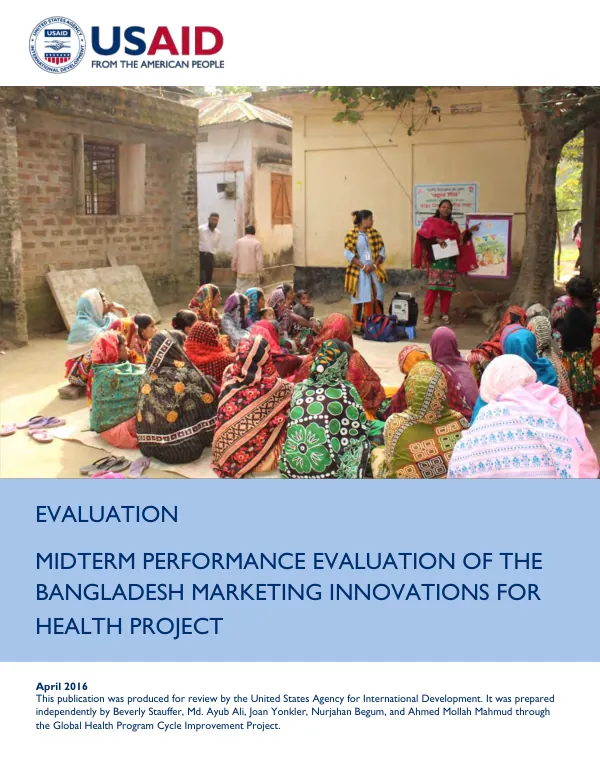
Initially, each FWA was assigned to visit a family planning unit of approximately 600 households every two months. However, as the population of women of reproductive age increased, the number of households requiring support from each FWA nearly doubled, leading to a dramatic decline in home visits. FWAs were also required to serve at community clinics three days per week, further increasing their workload. To address the gaps in household visits by fieldworkers, the Directorate General of Family Planning (DGFP) encouraged nongovernmental organizations (NGOs) to engage volunteers to reach women with family planning information and to strengthen community-facility referral linkages. EngenderHealth, through the Mayer Hashi II (MH-II) project, provided technical assistance to select NGOs to engage volunteers to disseminate family planning information, generate demand for family planning services, and refer prospective clients to the appropriate service delivery facility. The MH-II project engaged six local NGOs: BRAC, Mukti Nari-o-Shishu Unnayan Sangstha (Mukti), Population Services and Training Center (PSTC), Sushilan, the VPKA Foundation, and Young Power in Social Action (YPSA). With support from MH-II, these NGOs built the capacity of 4,135 volunteers and 325 supervisors to conduct family planning demand generation activities in their respective communities. The volunteer strategy included outreach and referral elements, with volunteers conducting interpersonal communication and group education sessions, identifying prospective family planning clients, and referring them to the nearest government or NGO facilities. The NGOs trained their volunteers and assigned them to conduct IPC and group education sessions, identify prospective family planning clients, and refer them to the nearest government or NGO facilities. Volunteers worked approximately eight days per month with a flexible schedule, and supervisors monitored the courtyard sessions and visited households to observe the quality of IPC conducted by volunteers and provided on-site coaching as needed. The project also established referral linkages between intervention NGOs and local DGFP facilities, with volunteers receiving a fee to cover the transportation cost for each LARC or PM uptake as a result of their referral. Between February 2015 and June 2017, the volunteers organized 34,108 courtyard education sessions with married women of reproductive age, visited 710,237 women at home, and identified, informed, and referred 242,278 women for injectables, LARCs, or PMs. Referrals by NGO volunteers were effective, with 83% of referred clients adopting a family planning method. The project's achievements demonstrate the potential of engaging volunteer networks to improve access to family planning services in rural areas of Bangladesh.
![Bangladesh Health Facility Survey 2017 [SPA28]](https://covers.devme.ai/gen/144484.webp)