USAID DEC
Midterm Performance Evaluation of the Workforce Improvement and Skill Enhancement Project
Sign inMINISTRY OF INTERNATIONAL TRADE AND INDUSTRY OF JAPAN
Midterm Performance Evaluation of the Workforce Improvement and Skill Enhancement Project
The Workforce Improvement and Skill Enhancement Project (WISE) in Egypt aimed to improve technical secondary education to meet job market needs, workforce skills and employability, and labor market efficiency.
2018 · 2 pages
Sign in to readA free account is required to download.
Abstract
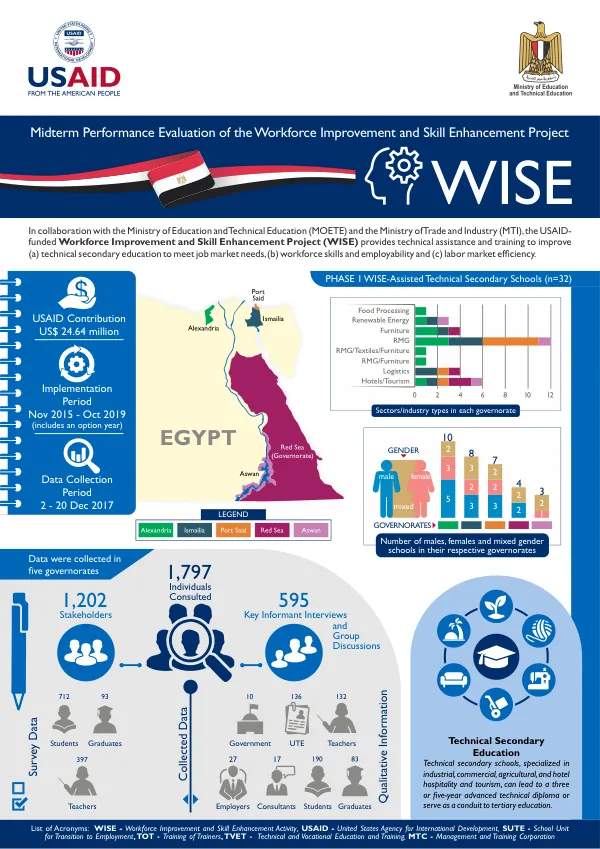
The project was implemented in collaboration with the Ministry of Education and Technical Education (MOETE) and the Ministry of Trade and Industry (MTI), with funding from the United States Agency for International Development (USAID). The project focused on 32 technical secondary schools in six governorates, including Alexandria, Ismailia, Port Said, Red Sea, and Aswan. The schools specialized in industrial, commercial, agricultural, and hotel hospitality and tourism, and offered three or five-year advanced technical diplomas or served as conduits to tertiary education. The project provided technical assistance and training to improve the quality of education and enhance the employability of students. Data collection for the midterm performance evaluation of the project was conducted from December 2 to 20, 2017, in the five governorates of Alexandria, Port Said, Ismailia, Red Sea, and Aswan. A total of 1,797 individuals were consulted, including 1,202 stakeholders, 712 students, 93 graduates, 397 teachers, and 27 employers. The data collected included key informant interviews, survey data, qualitative information, and group discussions. The project achieved several key outcomes, including the training of 114 career guidance facilitators and the introduction of career guidance materials and sessions. Additionally, 23 Master Trainers were trained on the 3R (Recruit-Retrain-Retain) methodology to work with private sector firms to improve their human resource strategies. The project also trained representatives of the Federation of Egyptian Industries and affiliates to provide technical assistance to 15 firms on applying the 3R methodology. The project reported results from Phase 1 WISE-Assisted Technical Secondary Schools, including job placement and on-the-job training. A total of 3,497 students were placed in jobs, with 1,145 students receiving on-the-job training. The project also expanded capacity building activities to SUTEs in 32 technical schools in six additional governorates. Female graduates were more likely to accept SUTE-arranged jobs because their parents trusted the schools to find safe jobs for their daughters. The project also introduced five new curricula in technical secondary education, including renewable energy and logistics specialties. A total of 59 school principals were trained on leadership and management, and 98 entrepreneurship facilitators were trained, benefiting more than 5,800 students. The project also established SUTEs in 28 technical schools in five governorates and built the capacity of its members. The project's achievements included the training of 59 school principals on leadership and management, 98 entrepreneurship facilitators, and 397 teachers on various fields. The project also trained 23 Master Trainers on the 3R methodology and representatives of the Federation of Egyptian Industries and affiliates to provide technical assistance to 15 firms. The project reported results on job placement and on-the-job training, with a total of 3,497 students placed in jobs and 1,145 students receiving on-the-job training. The project's geographic focus was on six governorates in Egypt, including Alexandria, Ismailia, Port Said, Red Sea, and Aswan. The project's timeframes were from November 2015 to October 2019, with data collection conducted from December 2 to 20, 2017. The project's recommendations included building on the advances of the "Logistics" and "Renewable Energy" curriculum development to improve linkages between upskilled students and private sector needs. The project's implementation details included the training of 114 career guidance facilitators, 23 Master Trainers on the 3R methodology, and representatives of the Federation of Egyptian Industries and affiliates to provide technical assistance to 15 firms. The project also established SUTEs in 28 technical schools in five governorates and built the capacity of its members. The project's achievements included the introduction of five new curricula in technical secondary education, including renewable energy and logistics specialties.
Related documents