DELOITTE CONSULTING, LLP
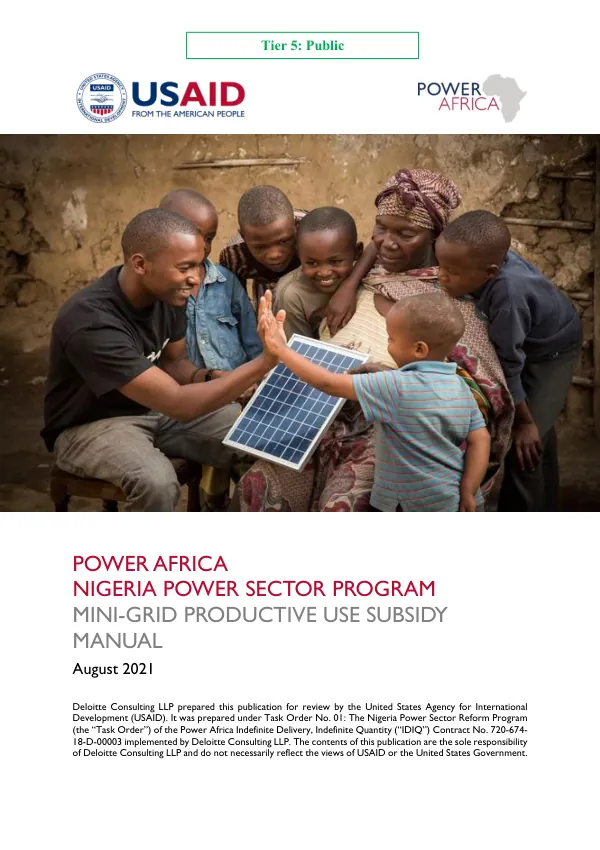
Mini-Grid Productive Use Subsidy Manual
The Nigeria Electrification Project (NEP) aims to increase access to electricity in underserved areas, with a focus on productive use of electricity.
2021 · 49 pages
Sign in to readA free account is required to download.
Abstract
The project is a component of the Power Africa Nigeria Power Sector Program (PA-NPSP), which is supported by the United States Agency for International Development (USAID). The NEP is designed to address the challenge of project economics in off-grid energy infrastructure, particularly in rural areas in Nigeria. To achieve this goal, the NEP focuses on increasing electricity demand through the electrification of commercial activities and overall economic development. This approach has a direct impact on demand for electricity service from the mini-grid. The project aims to increase the viability of project economics by leveraging the productive use of electricity. The NEP is a phased approach, with Phase 1 focusing on the development of a subsidy framework for the productive use of electricity. The framework is designed to support the establishment of mini-grids in underserved areas, with a focus on increasing electricity demand through the electrification of commercial activities. The subsidy framework is based on a phased approach, with the first phase focusing on the development of a productive use subsidy model. The subsidy model is designed to support the establishment of mini-grids in underserved areas, with a focus on increasing electricity demand through the electrification of commercial activities. The model is based on a tiered approach, with different levels of subsidy support depending on the level of productive use of electricity. The subsidy framework is designed to be flexible and adaptable to different project contexts. The NEP also focuses on the development of a phased approach to program implementation. The approach is designed to ensure that the project is implemented in a phased manner, with each phase building on the previous one. The phased approach allows for the evaluation of the project's impact and the identification of areas for improvement. The NEP also emphasizes the importance of stakeholder engagement and participation in the project. The project involves a range of stakeholders, including government agencies, private sector companies, and civil society organizations. The project aims to ensure that all stakeholders are engaged and involved in the project, and that their needs and concerns are addressed. The NEP also focuses on the importance of data collection and monitoring and evaluation. The project involves the collection of data on the project's impact and the monitoring and evaluation of the project's progress. The data collected is used to inform the project's decision-making and to identify areas for improvement. The NEP also focuses on the development of a phased approach to program implementation. The approach