WORLD BANK
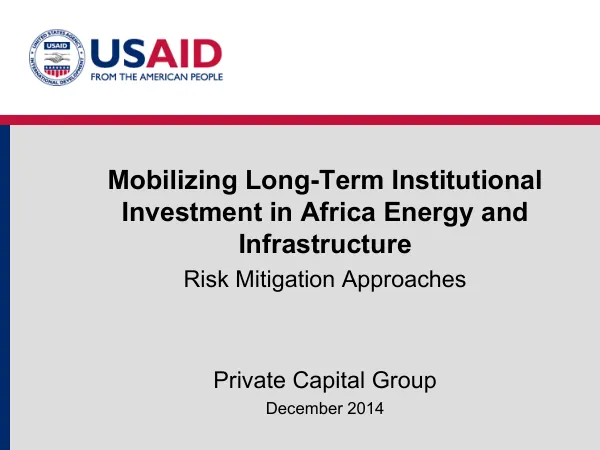
Mobilizing Long-Term Institutional Investment in Africa Energy and Infrastructure
Mobilizing Long-Term Institutional Investment in Africa Energy and Infrastructure Risk Mitigation Approaches began in 2014 as a Private Capital Group initiative.
2014 · 4 pages
Sign in to readA free account is required to download.
Abstract
The primary focus was on developing risk mitigation strategies to support African power projects. Key risk mitigation tools included partial risk guarantees, political risk insurance, performance bonds, and sovereign guarantees. These risk mitigation tools were designed to address various types of risks associated with infrastructure project development, such as performance risks, regulatory and institutional risks, contractor risks, and supply chain risks. The tools were categorized into different risk levels, ranging from lower risk to high risk, and were matched with corresponding return expectations. Risk mitigation approaches were tailored to specific project phases, including pre-feasibility, feasibility/project development, project structuring and negotiation, construction, and commercial operation. For example, during the pre-feasibility phase, concept identification and pre-feasibility analysis were conducted, followed by investor outreach and the issuance of a letter of intent. In the feasibility/project development phase, project financing and PPA and contract document negotiations were undertaken. During the construction phase, legal entity formation, construction agreement, and insurance agreements were executed. Finally, during the commercial operation phase, milestone review, verification of completion, and construction bond removal were conducted. The Private Capital Group identified several risk mitigation tools to support African power projects, including partial risk guarantees, political risk insurance, performance bonds, and sovereign guarantees. These tools were designed to address various types of risks associated with infrastructure project development, such as performance risks, regulatory and institutional risks, contractor risks, and supply chain risks. For example, the Azura – Edo IPP project structure involved a project company, Azura Power West Africa Ltd, which was responsible for developing the project. The project company was sponsored by a consortium of investors, including Amaya, Aldwych, ARM Infra Fund, and AIIF. The project involved a power purchase agreement with NBET, a performance bond with Siemens/Julius Berger, and a partial risk guarantee with MIGA and the World Bank. The risk mitigation instruments used in the Azura – Edo IPP project included a lender direct agreement with Standard Chartered Bank, a political risk insurance policy with MIGA, a performance bond with Siemens/Julius Berger, a power purchase agreement with NBET, and a put-call option agreement with the FGN. The project also involved a gas supply agreement with a gas aggregator and a gas transportation agreement. Overall, the Private Capital Group's initiative on mobilizing long-term institutional investment in Africa energy and infrastructure risk mitigation approaches aimed to develop risk mitigation strategies to support African power projects. The initiative identified various risk mitigation tools and approaches that could be used to address different types of risks associated with infrastructure project development.