AFRICAN CHRISTIAN HEALTH ASSOCIATION PLATFORM
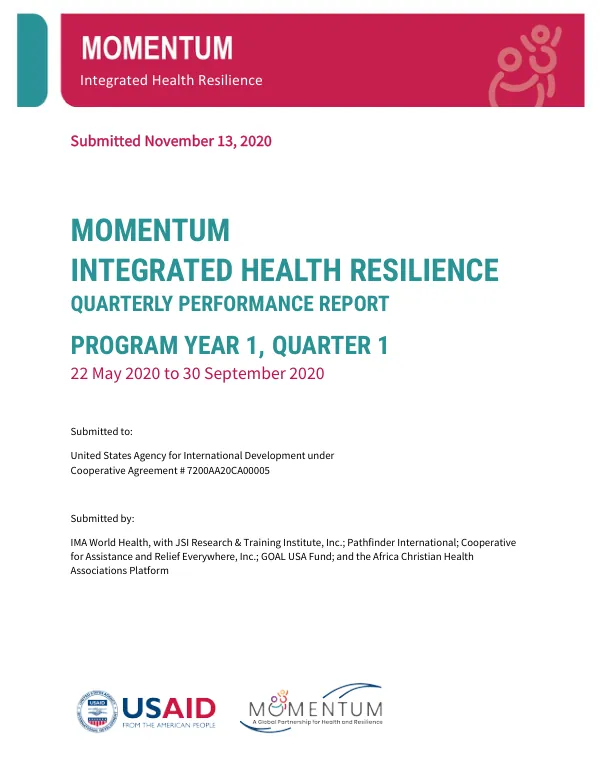
MOMENTUM Integrated Health Resilience PY1 Q1 Performance Report
MOMENTUM Integrated Health Resilience is a program aimed at improving maternal, newborn, and child health (MNCH) and family planning (FP) services in fragile settings.
2020 · 33 pages
Sign in to readA free account is required to download.
Abstract
The program is funded by the U.S. Agency for International Development (USAID) and implemented by IMA World Health, in partnership with several organizations. The program's goals are to increase access to and use of evidence-based, quality MNCH/FP/RH information, services, and interventions; improve the capacity of host-country institutions, local organizations, and providers to deliver evidence-based, quality MNCH/FP/RH services; increase adaptive learning and use of evidence in MNCH/FP/RH programming through sustained USAID and host country technical leadership; and increase cross-sectoral collaboration and innovative partnerships between MNCH/FP/RH and non-MNCH/FP/RH organizations. During the first quarter of Program Year 1, the program achieved several results. In terms of access to and use of evidence-based, quality MNCH/FP/RH information, services, and interventions, the program participated in ongoing fora for global thought leadership and policy dialogue on MNCH/FP/RH in fragile settings, consolidated a needs assessment toolkit for fragile contexts, and adapted specific technical guidance for fragile contexts. The program also made progress in improving the capacity of host-country institutions, local organizations, and providers to deliver evidence-based, quality MNCH/FP/RH services. This included adapting capacity building strategy and organizational capacity assessment tools for use in fragile settings, developing a grants management capacity strategy to support the strengthening of local partner organizations, and developing and testing a needs assessment tool to strengthen the role of civil society in improving the accountability and governance of health care workers and managers. In terms of adaptive learning and use of evidence in MNCH/FP/RH programming, the program made progress in availability, quality, and use of data, knowledge management, evaluation and research of innovations, digital health applications to strengthen MERL, KM, and technical approaches, MERL and KM capacity strengthening, and developing a health resilience framework and measures. The program also increased cross-sectoral collaboration and innovative partnerships between MNCH/FP/RH and non-MNCH/FP/RH organizations through framework for public-private partnership engagement, expand access to educational/training resources for health care providers in fragile contexts, establish framework for corporate and philanthropic partnering, and cross-sectoral engagement and cost-benefit analysis. The program's management structure includes a project management team, security and safety activities, and COVID-19 management. The program also engaged in country buy-in activities and additional resources and activities. The program's goals and results are outlined in Figure 1, which shows the program's objectives and the results achieved during the first quarter of Program Year 1. The program's progress is also reflected in the acronyms and abbreviations listed in the appendix, which provide a glossary of terms used throughout the report. The program's achievements during the first quarter of Program Year 1 demonstrate its commitment to improving MNCH/FP/RH services in fragile settings. The program's progress in increasing access to and use of evidence-based, quality MNCH/FP/RH information, services, and interventions, improving the capacity of host-country institutions, local organizations, and providers to deliver evidence-based, quality MNCH/FP/RH services, increasing adaptive learning and use of evidence in MNCH/FP/RH programming, and increasing cross-sectoral collaboration and innovative partnerships between MNCH/FP/RH and non-MNCH/FP/RH organizations is a significant step towards achieving the program's overall goals. The program's management structure and activities, including security and safety activities, COVID-19 management, country buy-in activities, and additional resources and activities, demonstrate the program's commitment to effective management and implementation. The program's use of acronyms and abbreviations provides a clear and concise way of communicating complex information. Overall, the program's achievements during the first quarter of Program Year 1 demonstrate its potential to make a significant impact in improving MNCH/FP/RH services in fragile settings. The program's progress and achievements provide a solid foundation for continued progress and success in the future.