HARVARD UNIVERSITY. HARVARD INSTITUTE FOR INTERNATIONAL DEVELOPMENT (HIID)
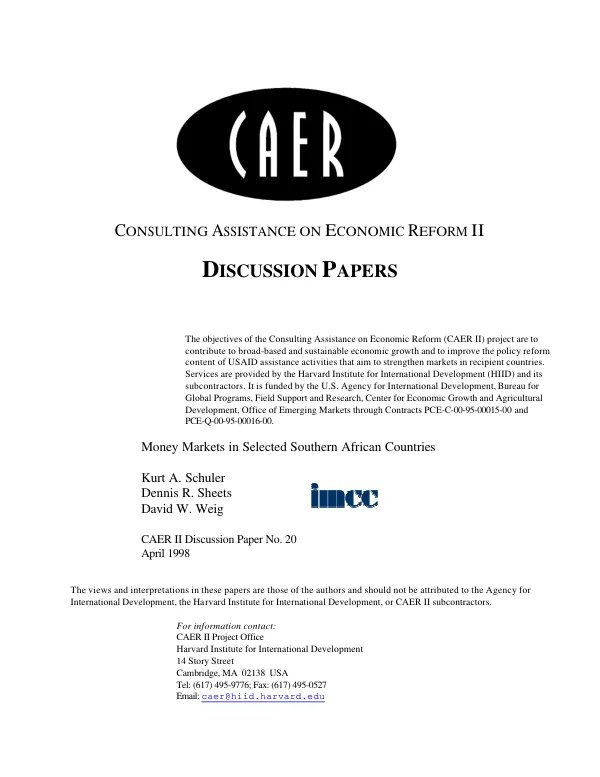
Money markets in selected southern African countries
A survey was conducted of money markets in Botswana, Tanzania, Uganda, and Zimbabwe, to both describe the current status of money markets and to assess potential needs for technical assistance.
Schuler, Kurt A.; Sheets, Dennis R. +1 more · 1998
Sign in to readA free account is required to download.
Abstract
Namibia and South Africa were also briefly examined. South Africa has the most active money markets in Africa and provides an example of how money markets in the other countries may develop. At present, there does not seem to be a strong need to develop new money market instruments in Botswana, Namibia, and Zimbabwe. In Tanzania and Uganda, it is possible that such a need may arise in the next few years. However, it may be worthwhile to expand the secondary market for Treasury bills in these countries, where purchasers of such bills tend to hold them to maturity instead of trading them on the secondary market. A key point is that a country can have a money market without a stock market, but it cannot have a stock market without at least a rudimentary money market. Stock markets rely on the infrastructure of banks and the payments system. The money market and the payments system can keep functioning even if the stock market experiences a crisis, but if the money market and the payments system do not function, the stock market cannot function either. Consequently, money markets and their institutions will play a larger role in economic development than stock markets in the target countries until those countries become considerably richer. Payments systems in the surveyed countries are uneven and increase the risk of defaults and therefore the potential for a chain of problems for others. The Southern African Development Community is making an effort to upgrade and integrate payments systems throughout the region. Improving the payments system is vital to helping money markets function effectively in the target countries, and there may be scope for technical assistance in Botswana, Tanzania, and perhaps Uganda. (Author abstract)
![Common Market for Eastern and Southern Africa (COMESA) : regional investors [i.e. investors"] roadmap -- final report](https://covers.devme.ai/gen/72592.webp)