COOPERS AND LYBRAND
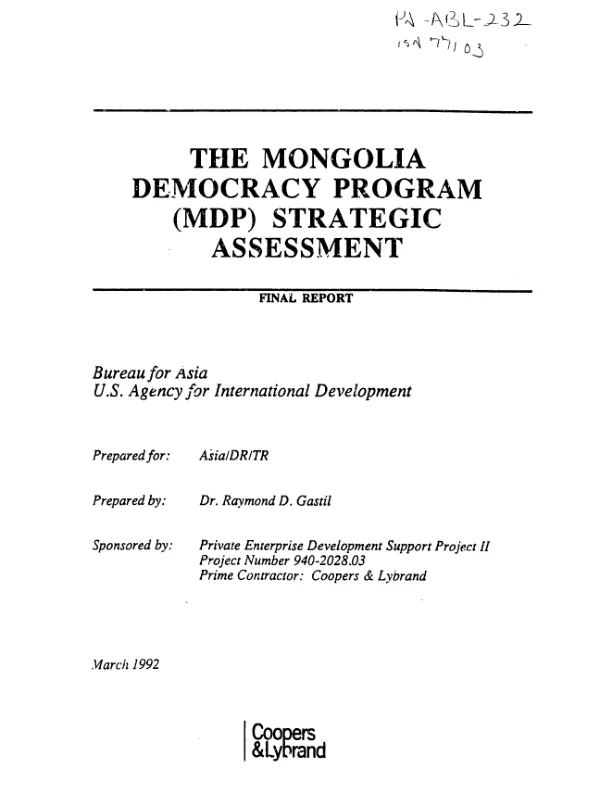
Mongolia democracy program (MDP) strategic assessment
For several reasons, the development of democracy in Mongolia is highly problematic.
Gastil, Raymond D. · 1992
Sign in to readA free account is required to download.
Abstract
Historically, Mongolians have had virtually no contact with Western institutions, particularly those of democracy. Recent history has been dominated by Communist ideology and the struggle between Russia and China for control over the country. Mongolia has also been heavily influenced for centuries by Tibetan Buddhism and its restrictive monastic environment. According to this report, the first task of a democracy program in this context is to build democratic institutions. It is proposed that USAID concentrate its efforts on English language training and curriculum development to provide broader exposure to Western ideas and experiences. The second task is to identify specific areas in Mongolia"s institutional or organizational life where more technical aid might be of greatest use. Key areas include training programs for journalists and public policy makers and support for a human rights organization and the women"s movement. In regard to governance, special attention should be given to developing a common research library for all three governmental branches. Because of the flux of institutional change, a strong and relatively centralized system is desirable to meet current crises; hence, no aid to local or regional government should be undertaken at this time. Efforts are needed, however, to establish an independent judiciary and legal profession and to ensure government accountability.
Related documents
![Final report of the DG [democracy and governance] TDY team to Guinea](https://covers.devme.ai/gen/63822.webp)