USAID DEC
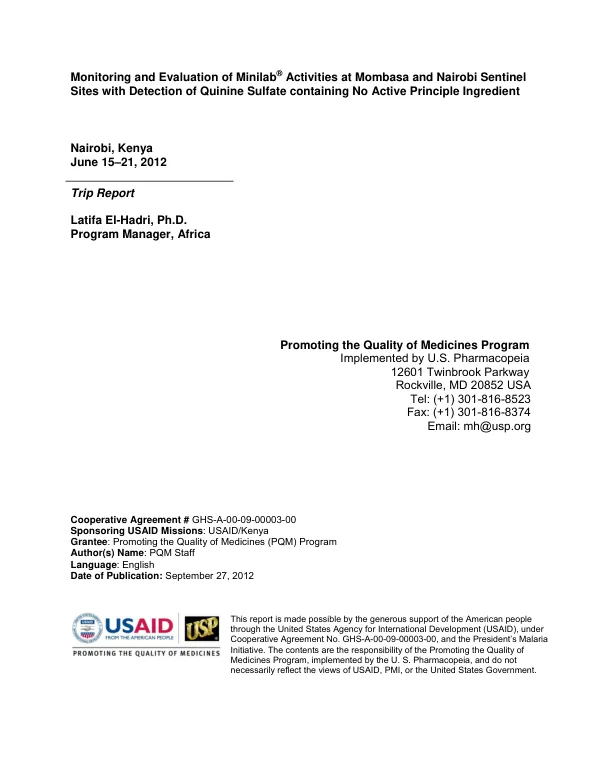
Monitoring and Evaluation of Minilab Activities at Mombasa and Nairobi Sentinel Sites
Sign inMANAGEMENT SCIENCES FOR HEALTH
Monitoring and Evaluation of Minilab Activities at Mombasa and Nairobi Sentinel Sites
The Promoting the Quality of Medicines (PQM) program, funded by the U.S.
2012 · 20 pages
Sign in to readA free account is required to download.
Abstract
Agency for International Development (USAID), is a response to the growing challenge posed by the proliferation of counterfeit and substandard medicines. PQM provides technical assistance to developing countries, including Kenya, to build local capacity in medicines quality assurance systems, increase the supply of quality medicines to priority USAID health programs, and ensure the quality and safety of medicines globally. In Kenya, PQM began working in November 2009, conducting an assessment of the quality assurance structures in the country. Following this assessment, PQM established a sustainable protocol for monitoring the quality of antimalarial medicines at five sentinel sites. In January 2010, PQM trained 14 staff members from the central and regional levels on sampling strategies, Minilab basic tests, and data reporting. The first round of medicines quality monitoring (MQM) took place in the spring of 2010, with a total of 536 samples collected. The results of basic testing for this round revealed that 45 antimalarials were not registered and 74 had expired. The companies associated with the unregistered products were identified, and the inspectorate team was instructed to take appropriate action. In September 2010, PQM evaluated the first round of Minilab activities and validated the samples selected for confirmatory testing at the National Quality Control Laboratory (NQCL) in Nairobi. PQM staff pointed out process gaps to the sentinel site teams and provided solutions to improve future rounds of testing. The main challenge was the lack of availability of trained personnel during sample testing, and all concerned parties suggested a need for training additional personnel from NQCL and the sentinel sites. In January 2011, PQM facilitated Minilab training for an additional 14 staff from the Pharmacy and Poisons Board (PPB) and NQCL. The Minilab program team leaders rolled out this training in March 2011 at the NQCL. In January 2012, PQM presented the results of past post-marketing surveillance (PMS) rounds and the actions taken by the PPB in regards to unregistered, expired, and failed antimalarial samples. The purpose of the trip was to conduct a monitoring and evaluation (M&E) visit to two sentinel sites, collect samples with related adverse drug events from selected outlets, and present the results. The M&E visit was conducted at the Mombasa and Nairobi sentinel sites, where PQM staff found other antimalarial samples that failed basic testing. The National Quality Control Laboratory (NQCL) staff will carry out confirmatory testing on all failed samples and on 20% of samples that pass the Minilab basic tests. The World Health Organization (WHO) estimates that approximately 40% of the world population living in developing countries, including Kenya, is still at risk from malaria. Medicines intended for the treatment of severe malaria that are fake, counterfeit, or substandard pose a profound health risk to patients who rely upon the drugs to be effective. In collaboration with the Pharmacy and Poisons Board (PPB), the National Quality Control Laboratory (NQCL), and the Division of Malaria Control of Kenya (DOMC), PQM organized the third round of monitoring the quality of antimalarial medicines (MQM) at five sentinel sites. During this exercise, the sentinel site team of Kisumu and Kakamega found samples of quinine sulfate—a commonly used treatment for severe cases of malaria—with no active pharmaceutical ingredient (API). The PPB deemed these to be counterfeit products, quickly withdrew them from the market, and sent the supplier to jail. Another non-registered antimalarial quinine injection was found in a Nairobi sentinel site, which failed confirmatory testing. Like the fake quinine sulfate, PPB took the necessary regulatory actions; investigations are ongoing in both cases. The monitoring and evaluation visits of the Mombasa and Nairobi sites revealed other antimalarial samples that failed basic testing. The NQCL staff will carry out confirmatory testing on all failed samples and on 20% of samples that pass the Minilab basic tests. The results of the MQM exercise will be presented to the stakeholders, and the necessary actions will be taken to address the quality concerns.
Related documents