USAID DEC
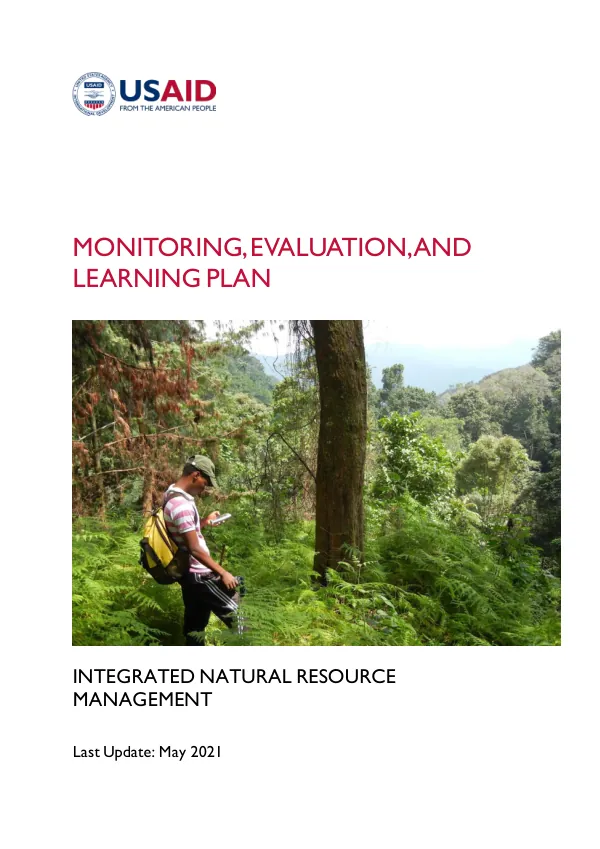
Monitoring, Evaluation, and Learning Plan for Integrated Natural Resource Management
Sign inDAI
Monitoring, Evaluation, and Learning Plan for Integrated Natural Resource Management
Integrated Natural Resource Management (INRM) is a task order under the Strengthening Tenure and Resource Rights II (STARR II) IDIQ, sponsored by the USAID Center for Environment, Energy, and Infrastructure.
2021 · 64 pages
Sign in to readA free account is required to download.
Abstract
The contract number is 7200AA20F00010, and the task order number is STARR II – 7200AA18D00020. The period of performance is from July 30, 2020, to July 19, 2025. The INRM activity aims to improve the management of natural resources in Rwanda, with a focus on integrated approaches that balance economic, social, and environmental considerations. The activity is guided by a theory of change that outlines the expected outcomes and impact of the INRM interventions. The theory of change is linked to the Environmental and Natural Resource Management (ENRM) framework, which provides a broader context for the INRM activity. The INRM activity is based on several assumptions, including the need for integrated natural resource management approaches, the importance of community engagement and participation, and the potential for INRM to contribute to poverty reduction and improved livelihoods. The activity will be monitored and evaluated using a range of indicators, including those related to land, gender, and biodiversity. The monitoring plan for the INRM activity includes indicator-based monitoring, with a focus on tracking progress towards the expected outcomes and impact. The plan also includes consideration of standard indicators, such as those related to land tenure and biodiversity conservation. The evaluation and learning plan for the INRM activity includes outcome harvesting, learning questions, and INRM learning tools. Data and knowledge management are critical components of the INRM activity, with a focus on collecting, storing, and analyzing data to inform decision-making and learning. The activity will use a range of data collection approaches, including surveys, focus groups, and monitoring data collection. The data will be stored and secured in accordance with USAID guidelines, and access will be restricted to authorized personnel. The INRM activity will be implemented by DAI, with a team led by Mike Duthie and Christina Seybolt. The activity will be supported by a range of stakeholders, including USAID, the Government of Rwanda, and local communities. The INRM activity is expected to contribute to improved natural resource management in Rwanda, with a focus on integrated approaches that balance economic, social, and environmental considerations. The INRM activity will be monitored and evaluated using a range of indicators, including those related to land, gender, and biodiversity. The activity will also use a range of data collection approaches, including surveys, focus groups, and monitoring data collection. The data will be stored and secured in accordance with USAID guidelines, and access will be restricted to authorized personnel.