DAI
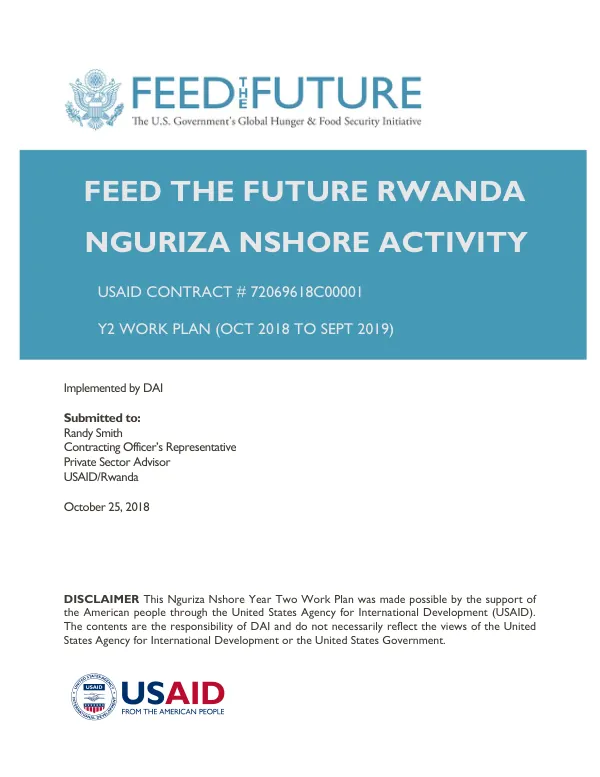
Nguriza Nshore Year Two Work Plan
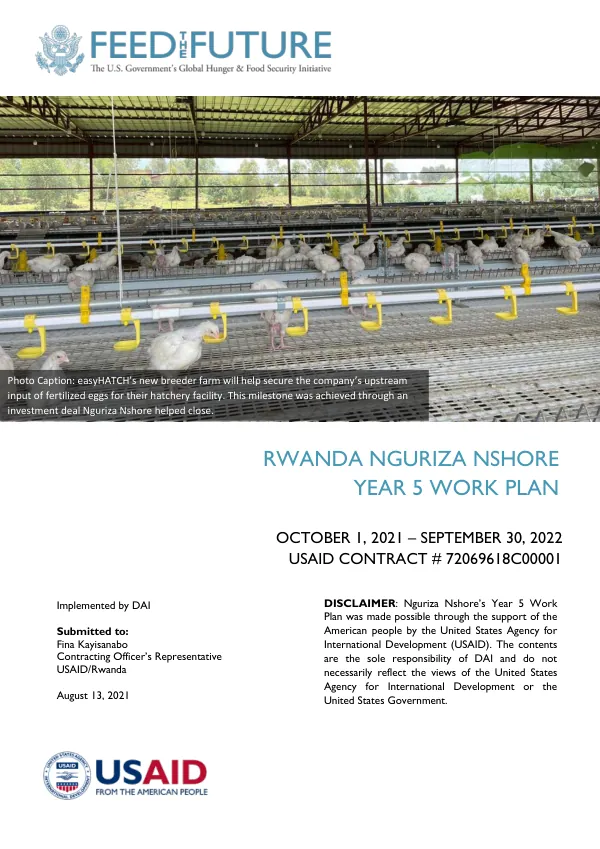
The Nguriza Nshore Activity is a five-year USAID project implemented by DAI, with a budget of $14,946,186.
2018 · 55 pages
Sign in to readA free account is required to download.
Abstract
The project's purpose is to drive rural economic growth in Rwanda by facilitating the emergence of dynamic small to medium enterprises (SMEs) and agribusiness sectors. The project aims to alleviate constraints to investment and increase access to financing, thereby facilitating the creation and expansion of SMEs as an entry point for widespread economic growth and social development. The project's geographic focus prioritizes the 13 districts of the new Feed-the-Future (FTF) zone of influence (ZOI), but it will also support interventions outside of these priority areas to leverage economies-of-scale in urban and peri-urban locations. Financing for SMEs in Rwanda is still nascent, and this dearth of funding severely constrains the growth, profitability, and job creation potential of growing companies. Nguriza Nshore is designed to solve this problem by crowding-in growth capital for SMEs, thereby elevating living standards for ordinary Rwandans, driving GDP growth for the country, and fueling employment for the next generation. The project will work with financial institutions, investors, transaction advisors, consulting firms, and various Government of Rwanda institutions to serve as a catalyst that unlocks debt from a wide variety of financial institutions (FIs), facilitates investment from international, regional, and local sources, and improves the policy and regulatory environments for entrepreneurs and businesses. This will leave behind a better functioning finance and investment ecosystem once the project concludes. Nguriza Nshore will follow a standard process from partner sourcing and selection to deal making and policy implementation. The project will identify and select partners, including financial institutions, investors, and transaction advisors, to work with in achieving its objectives. The project will then facilitate deal making between these partners and SMEs, providing support and guidance as needed. Additionally, the project will work with Government of Rwanda institutions to improve the policy and regulatory environments for entrepreneurs and businesses. The project's activities will be focused on three main components: improving the capacity of financial institutions to lend to off-farm SMEs, increasing private and commercial investment in off-farm SMEs, and strengthening the enabling environment to create the conditions for off-farm SMEs to increase business performance and profitability. The project will also have cross-cutting initiatives and program implementation support, including gender and social inclusion, monitoring and evaluation, communications, knowledge management and learning, and environmental compliance. The project's geographic focus is on the 13 districts of the new FTF zone of influence (ZOI), but it will also support interventions outside of these priority areas. The project's timeframes are from October 2018 to September 2019, with a five-year duration from April 24, 2018, to April 23, 2023. The project's budget is $14,946,186, and it is implemented by DAI.
Related documents