USAID DEC
Monitoring for Climate Change Impacts on Species, Ecosystems, Ecosystem Services, People and Agricultural Services
Sign inCONSERVATION INTERNATIONAL FOUNDATION
Monitoring for Climate Change Impacts on Species, Ecosystems, Ecosystem Services, People and Agricultural Services
Climate change impacts on species, ecosystems, ecosystem services, people, and agricultural services are a pressing concern.
2011 · 32 pages
Sign in to readA free account is required to download.
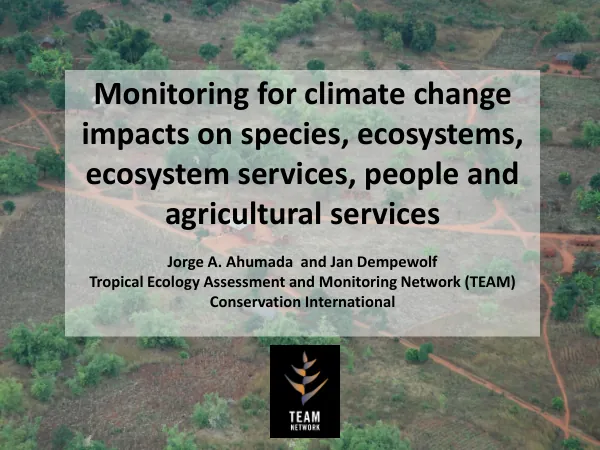
Abstract
The Tropical Ecology Assessment and Monitoring Network (TEAM) and Conservation International have developed a Monitoring and Evaluation Framework for climate adaptation. This framework aims to identify key drivers, resource bases, and outcomes for monitoring and risk assessment. The framework involves designing interventions, indicators, and temporal and spatial scales to monitor ecosystem services, agro-ecological systems, human livelihoods, and natural systems. Ecosystem services include parameters such as water, soil nutrients, fuelwood, and biodiversity. Agro-ecological systems involve agricultural yield, household income, nutrition, and habitat extent. Human livelihoods encompass parameters such as people, environment, and sustainability. The framework also focuses on adaptation to climate change, with main monitoring elements including agriculture, human livelihoods, ecosystem services, and sustainability. Parameters such as agricultural yield, household income, nutrition, water, soil nutrients, fuelwood, biodiversity, and habitat extent are monitored to assess the effectiveness of interventions. The framework also considers tradeoffs and unintended consequences of particular actions. The Monitoring and Evaluation Framework for AGRA (Agricultural Growth and Rural Advancement) aims to measure agriculture's human wellbeing and environmental outcomes, prevent unintended consequences, and conserve ecosystem services. The framework involves measuring parameters such as agricultural yield, household income, nutrition, water, soil nutrients, fuelwood, biodiversity, and habitat extent. It also considers the effectiveness and adaptive management of interventions, as well as the environmental and human livelihood consequences of particular actions. The framework uses information layers, including primary observations, analytical outputs, variables of system attributes, decision layers, and synthetic, diagnostic indicators. These layers help to assess the system state and performance, enabling informed decision-making and prioritization of natural areas for protection. The framework also considers planning, prioritizing, and minimizing unintended consequences, ultimately aiming to promote sustainability and adaptation to climate change.
Related documents
Documents in this collection
 2016
2016USAID DEC
Accelerating Agriculture Productivity Improvement in Bangladesh: Mitigation co-benefits of nutrient and water use efficiency
Open record 2014
2014USAID DEC
Agricultural Practices Promoted and Adopted in Mali: Results of a Survey of Nongovernmental Organizations and Focus Groups of Farmers
Open record