SOCIAL IMPACT, INC.
Mekong River Delta Climate Change Mitigation Assessment
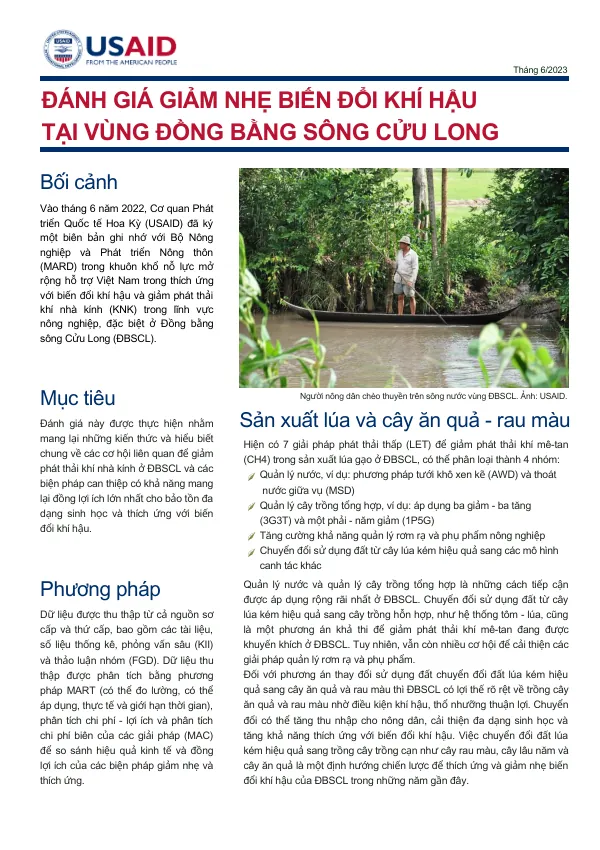
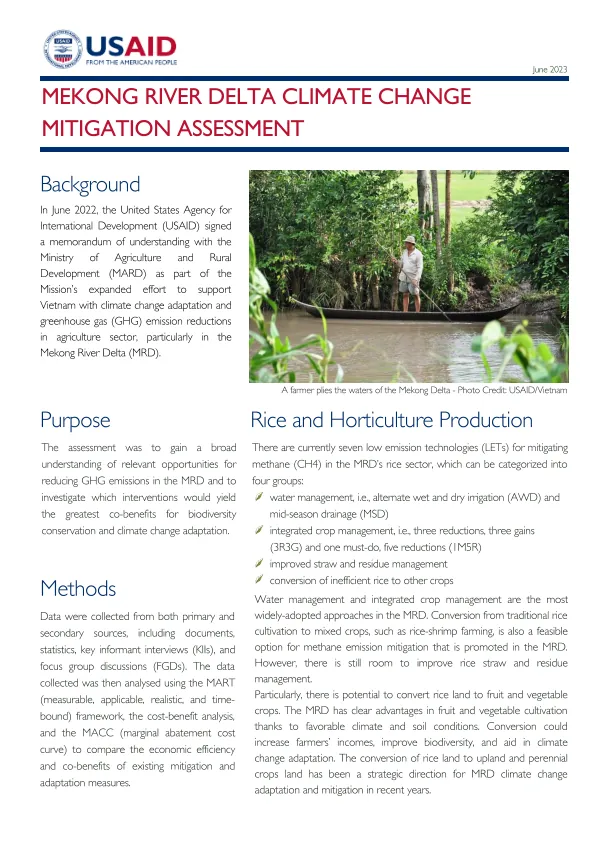
The Mekong River Delta (MRD) climate change mitigation assessment was conducted in June 2022 as part of the United States Agency for International Development (USAID) expanded effort to support Vietnam with climate change adaptation and greenhouse gas (GHG) emission reductions in the agriculture sector.
2023 · 2 pages
Sign in to readA free account is required to download.
Abstract
The assessment aimed to gain a broad understanding of relevant opportunities for reducing GHG emissions in the MRD and to investigate which interventions would yield the greatest co-benefits for biodiversity conservation and climate change adaptation. The assessment identified seven low emission technologies (LETs) for mitigating methane (CH4) in the MRD's rice sector, which can be categorized into four groups: water management, integrated crop management, improved straw and residue management, and conversion of inefficient rice to other crops. Water management and integrated crop management are the most widely-adopted approaches in the MRD, with conversion from traditional rice cultivation to mixed crops, such as rice-shrimp farming, also being a feasible option for methane emission mitigation. The assessment also highlighted the potential for converting rice land to fruit and vegetable crops, which could increase farmers' incomes, improve biodiversity, and aid in climate change adaptation. The MRD has clear advantages in fruit and vegetable cultivation due to favorable climate and soil conditions. Additionally, the conversion of rice land to upland and perennial crops has been a strategic direction for MRD climate change adaptation and mitigation in recent years. Ruminant (beef and dairy) production plays an important role in MRD farmers' livelihood and economic development, particularly for ethnic minority groups in Soc Trang province. Changing feed rations through silages and biochar supplements, increasing the feed ration concentration, and making compost and biogas for beef manure treatment can be promising approaches for methane emission reduction in the MRD. The MRD has the largest amount of mangroves in Vietnam, hosting approximately 55 percent of the total quantity nationwide. Mangrove restoration and sustainable management are considered a high priority in Vietnam's Nationally Determined Contribution (NDC) to effectively respond to climate change. The cost of mangrove restoration depends on site conditions and varies from USD 4,100 to USD 8,343 per ha over four years. Mangrove carbon sequestration varies from species to species and among different forest management interventions, with an average carbon sequestration rate of 24.5 tons of carbon dioxide per ha per year. Other MRD blue carbon ecosystems are seagrass and melaleuca. MRD has about 15,000 ha of seagrass, mostly distributed in Phu Quoc island, and 50,000 ha of melaleuca, mostly distributed in Ca Mau. Seagrass has been degraded by human activities such as tourism, urbanization, fishery farming, and water pollution, while Melaleuca's forest area is quickly decreasing, mostly due to fires caused by honey harvesting, forest conversion to Acacia plantations, and other land use conversion for socio-economic development. Recommendations for USAID include supporting technical research in GHG emissions in Vietnam in general and in MRD specifically to fully develop a quantification method for GHG emission reductions. Additionally, USAID is recommended to assist with technology transfer to modernize mitigation projects, provide support to develop a carbon credit system for implemented mitigation options that is linked with the carbon market to exchange carbon credit, and join the international support for NDC in agriculture through small-scale projects of improving infrastructure, such as in-field irrigation system for alternate wet and dry irrigation (AWD) and high level of scadar system for a large-scale irrigation for AWD and mid-season drainage (MSD).