CAROLINA POPULATION CENTER AT THE UNIVERSITY OF NORTH CAROLINA AT CHAPEL HILL
Monitoring Outcomes of PEPFAR Orphans and Vulnerable Children Programs in Kenya
The Walter Reed Program/Henry M.
2019 · 1 pages
Sign in to readA free account is required to download.
Abstract
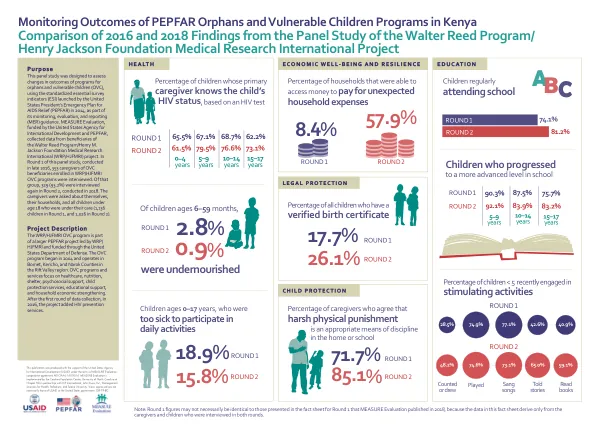
Jackson Foundation Medical Research International (WRP/HJFMRI) project in Kenya provides programs for orphans and vulnerable children (OVC). The project operates in Bomet, Kericho, and Narok Counties in the Rift Valley region, focusing on healthcare, nutrition, shelter, psychosocial support, child protection services, educational support, and household economic strengthening. The project began in 2004 and added HIV prevention services in 2016. The project's OVC program was assessed through a panel study conducted by MEASURE Evaluation, funded by the United States Agency for International Development and PEPFAR. The study collected data from caregivers of OVC beneficiaries enrolled in the WRP/HJFMRI OVC programs. In Round 1, conducted in late 2016, 353 caregivers were interviewed, and 329 (93.2%) were interviewed again in Round 2, conducted in 2018. The caregivers were asked about themselves, their households, and all children under age 18 who were under their care. The study found significant improvements in various outcomes between 2016 and 2018. The percentage of children who progressed to a more advanced level in school increased from 76.6% to 79.5%. The percentage of households that were able to access money to pay for unexpected household expenses increased from 61.5% to 65.5%. The percentage of caregivers who agree that harsh physical punishment is an appropriate means of discipline in the home or school decreased from 68.7% to 67.1%. The percentage of children whose primary caregiver knows the child's HIV status, based on an HIV test, increased from 71.7% to 85.1%. The study also found improvements in children's health and nutrition outcomes. The percentage of children under 5 who were recently engaged in stimulating activities increased from 48.2% to 74.6%. The percentage of children whose primary caregiver knows the child's HIV status, based on an HIV test, increased from 71.7% to 85.1%. The percentage of children who were too sick to participate in daily activities decreased from 57.9% to 15.8%. The study also found improvements in children's education outcomes. The percentage of children who attended school increased from 90.3% to 92.1%. The percentage of children who regularly attended school increased from 74.1% to 81.2%. The percentage of children who were able to read books increased from 40.9% to 74.9%. The percentage of children who were able to tell stories increased from 28.5% to 77.1%. The study's findings suggest that the WRP/HJFMRI project's OVC program has had a positive impact on the lives of OVC in Kenya. The project's focus on healthcare, nutrition, shelter, psychosocial support, child protection services, educational support, and household economic strengthening has led to significant improvements in various outcomes. The project's addition of HIV prevention services in 2016 has also contributed to the improvements in children's health and nutrition outcomes.
Related documents