USAID DEC
Evaluation of Services for Orphans and Vulnerable Youth in Botswana: Quantitative Findings
Sign inCAROLINA POPULATION CENTER AT THE UNIVERSITY OF NORTH CAROLINA AT CHAPEL HILL
Evaluation of Services for Orphans and Vulnerable Youth in Botswana: Quantitative Findings
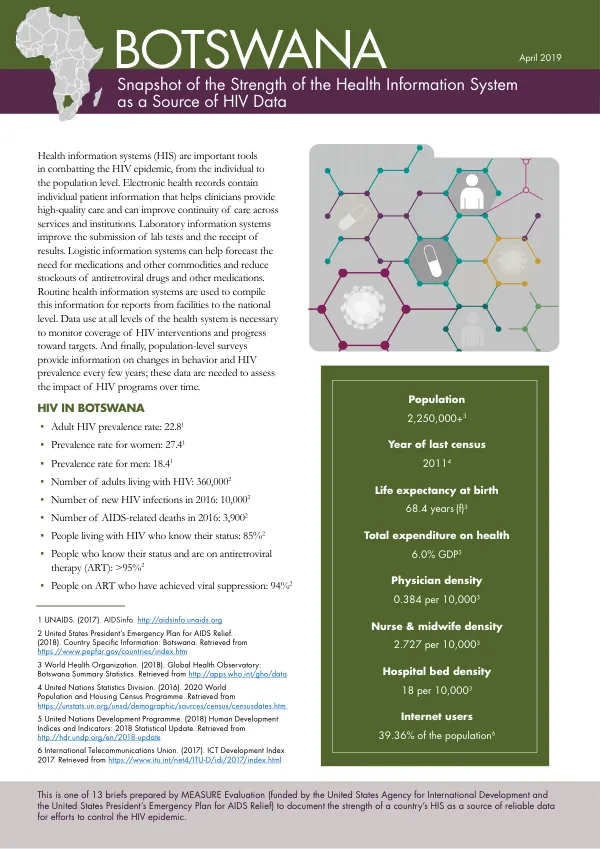
The Botswana Comprehensive Care and Support for Orphans and Vulnerable Children (BCCOVC) Project, funded by the United States President's Emergency Plan for AIDS Relief (PEPFAR), has been implemented in seven PEPFAR priority sites in Botswana since 2016.
2019 · 4 pages
Sign in to readA free account is required to download.
Abstract
The project is implemented by Project Concern International (PCI) and builds on the previous PCI-implemented Tsela Kgopo OVC and Gender project (2011-2016). The BCCOVC project supplements the core package of Government of Botswana (GOB) services for orphans and vulnerable children (OVC), providing food, school uniforms, clothes, shoes, and toiletry items to orphaned and vulnerable youth. The project's goals are to increase uptake of HIV testing and other reproductive health services, strengthen economic opportunities for young people, and improve educational outcomes. The MEASURE Evaluation project, funded by the United States Agency for International Development (USAID) and PEPFAR, conducted an evaluation to determine whether OVC beneficiaries who have participated in one to two years of OVC services from the GOB and BCCOVC project have better health, economic, and educational outcomes than do OVC beneficiaries who received only the GOB's OVC services. The study employed a two-arm quasi-randomized design, collecting data from 2,358 youth in September-December 2018, through household visits, with follow-up phone calls to 206 Form 5 students in February 2019 to collect data on educational outcomes. Quantitative data were analyzed to explore bivariate associations between the study arm and primary and secondary outcomes. Multivariate logistics and linear regressions were used to examine study outcomes, controlling for age, sex, school status, orphanhood, and primary caregiver. The evaluation found that youth in the intervention arm were marginally significantly more likely to receive medical care or psychological services because of Gender-Based Violence (GBV) in the previous 12 months. Approximately 20 percent of all participants reported receiving both BCCOVC and GOB services, while 55 percent reported having received only GOB services, and 6 percent reported receiving only BCCOVC services. About 11 percent of youth reported receiving no services. The evaluation also found that youth in the intervention arm were significantly more likely to have had an HIV test in the past 12 months and know their results than were youth in the comparison arm. Youth in the intervention arm were also significantly more likely to have accessed any HIV service (HIV prevention, testing, and treatment advice) than were youth in the comparison arm. The evaluation found that youth in the intervention arm were significantly more likely to be financially literate than those in the comparison arm, though the 0.1 difference in the mean score for financial literacy between the two groups was not programmatically meaningful. Youth in the intervention arm were also significantly more likely than those in the comparison arm to report starting a small business or an income-generating activity in the past 12 months, working for cash in the past three months, and saving money in the past 12 months. However, there were no differences in school enrollment or graduating from senior secondary school between youth in the intervention and comparison arms. The evaluation concluded that the PEPFAR-funded BCCOVC project has had some positive effects on HIV testing, treatment, and access to services, and on strengthening economic prospects for youth beneficiaries. However, no quantifiable effects of the BCCOVC intervention on education outcomes were observed.