USAID DEC
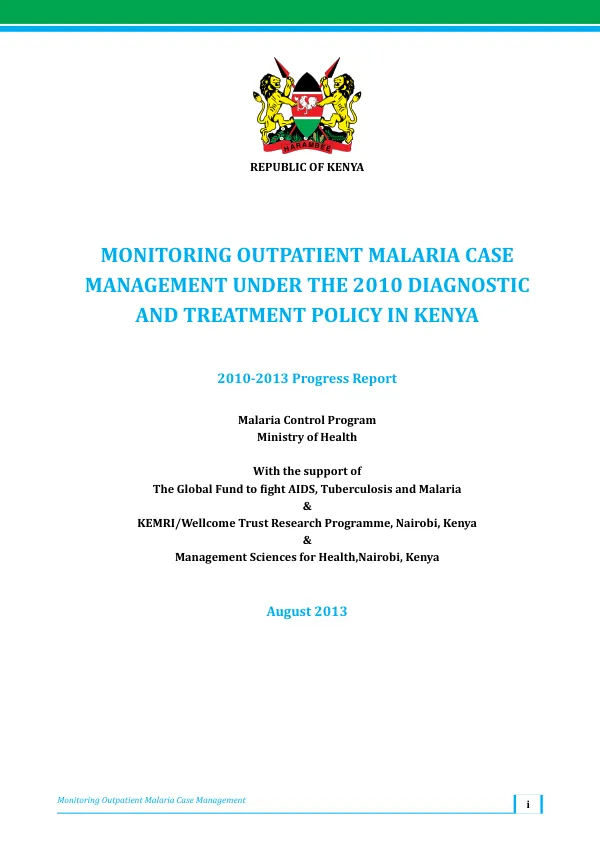
Monitoring Outpatient Malaria Case Management under the 2010 Diagnostic and Treatment Policy in Kenya
Sign inMANAGEMENT SCIENCES FOR HEALTH
Monitoring Outpatient Malaria Case Management under the 2010 Diagnostic and Treatment Policy in Kenya
The 2010-2013 Progress Report on Monitoring Outpatient Malaria Case Management in Kenya highlights the country's efforts to strengthen capacity for malaria diagnosis and treatment, increase access to affordable malaria medicines, and improve community case management of malaria.
2013 · 48 pages
Sign in to readA free account is required to download.
Abstract
The report presents the progress in key national M&E malaria-related health systems and case-management indicators during this period. The Kenya National Malaria Strategy (NMS) 2009/2017 aims to have 80 percent of all self-managed fever cases receive prompt and effective treatment and 100 percent of all fever cases who present to health facilities receive parasitological diagnosis and effective treatment. By 2013, the time of mid-term policy performance review, the NMS specified programmatic directions to ensure universal availability of ACTs and diagnostics, universal coverage of health facilities and health workers with health systems support activities, and universal health worker's adherence to malaria case-management treatment guidelines. The Ministry of Health's Malaria Control Program (MCP) has been undertaking national monitoring surveys on a biannual basis to assess the Quality of Care (QOC) accorded to malaria patients and monitor policy adherence. The baseline survey was carried out in January/February 2010, and the last follow-up survey in June 2013 prior to the mid-term policy performance review. The report presents the progress in key national M&E malaria-related health systems and case-management indicators during this period. The findings showed that nearly all key indicators around the test and treat policy for malaria had shown significant improvements by mid-2013. The report highlights the importance of strengthening health systems support activities, including the availability of basic equipment and malaria diagnostics, antimalarial drugs, and guidelines and job aids. The report also emphasizes the need to improve health workers' adherence to national guidelines for malaria case management. The report provides useful information regarding the achievements and gaps in monitoring outpatient malaria case management in the country. Recommendations have been made to effectively reduce the gaps in an attempt to achieve universal availability of malaria case-management commodities and strengthen health workers' adherence to national guidelines for malaria case management. The report highlights the importance of continued support from stakeholders, including the Global Fund to Fight AIDS, Tuberculosis and Malaria, the U.S. President's Malaria Initiative/USAID, and the Management Sciences for Health/Health Commodities and Services Management (HCSM) program. The report also acknowledges the support from the Wellcome Trust-UK, Kenya Medical Research Institute, and University of Oxford. The report concludes that the progress made in key national M&E malaria-related health systems and case-management indicators during this period is a significant step towards achieving the goals of the NMS. However, there is still a need to address the gaps in health systems support activities and health workers' adherence to national guidelines for malaria case management. The report provides a useful framework for future management of malaria and will guide the next steps in the journey to achieve a malaria-free Kenya.
Related documents