PRESIDENT'S EMERGENCY PLAN FOR THE U.S. FOR AIDS RELIEF
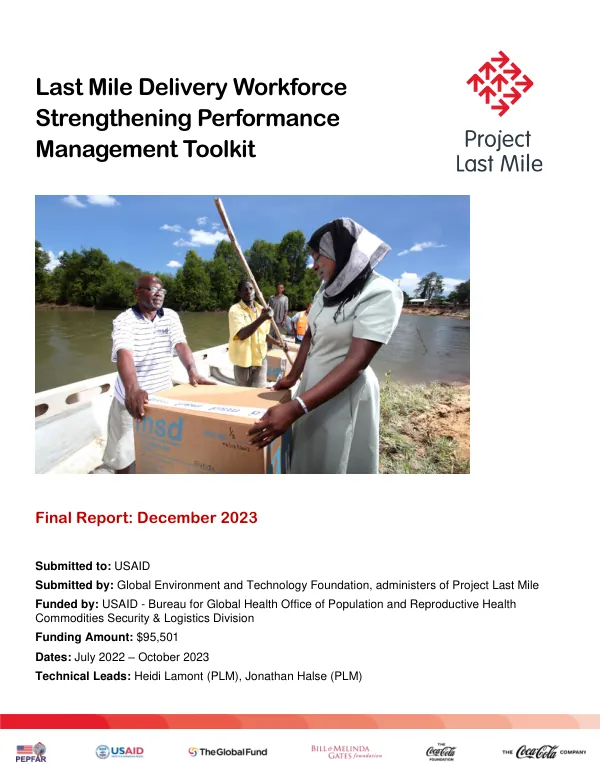
Final Report: December 2023
The Last Mile Delivery Workforce Strengthening Performance Management Toolkit was developed to support health systems in improving the deployment and availability of essential medicines at the point of patient care.
2023 · 11 pages
Sign in to readA free account is required to download.
Abstract
The project aimed to leverage best practices from The Coca-Cola Company System (TCCS) in Africa to strengthen the performance management of Last Mile Delivery (LMD) activities. The project was funded by USAID's Bureau for Global Health Office of Population and Reproductive Health Commodities Security & Logistics Division, with a total funding amount of $95,501. The project was implemented from July 2022 to October 2023, with technical leads Heidi Lamont and Jonathan Halse from the Global Environment and Technology Foundation, which administers Project Last Mile. The project's overarching goal was to support health systems in improving the deployment and availability of essential medicines at the point of patient care. This was to be achieved through improving workforce performance in the health sector, with a focus on enabling Ministry of Health (MoH) and Central Medical Stores (CMS) to apply PLM's specialized expertise and on-the-ground experience in designing and piloting LMD and customer service models. The project involved several key activities, including conducting an internal landscape review of the latest TCCS best practices, alignment on performance management gaps, and development of a toolkit and supporting tools. The PLM team conducted an internal landscape review of the latest TCCS resources across Africa to capture best practices, identify assets, and capacity-building resources relevant to LMD workforce strengthening. The team selected The People Framework, used by Coca-Cola Beverages Africa, as a basis for the toolkit due to its adaptability to cover a diverse range of operating cultures and levels of capability within the countries that CCBA operates in. An evaluation was conducted of the existing tools successfully utilized in PLM LMD interventions in Liberia, Sierra Leone, Tanzania, Uganda, and Kenya, with the aim of understanding how these could potentially be adapted. The PLM team developed an initial concept for the toolkit, with two distinct stages to implement a performance management process within the LMD workforce. The scope of LMD activities and workforce to be impacted by the toolkit was determined using the Integrated Public Health Supply Chain Model. The final design and scope of the toolkit agreed upon included performance enhancement elements, LMD activities, and LMD workforce covered in the toolkit. The toolkit includes performance management process and routines, such as cascading purpose to individual objectives, setting SMART goals, preparing for review meetings, and conducting effective review meetings. It also includes reward and recognition elements, such as financial and non-financial performance recognition recommendations, accurate and timely order calculation and placement, and completion of all required delivery documentation. The toolkit was made available through in-country workshops in Togo and Rwanda and is freely accessible online.
Related documents
Documents in this collection
 2020
2020USAID DEC
Food Safety Interventions in Africa and Asia: A Review of Studies Relevant to Traditional Markets in Low-Resource Settings
Open record 2020
2020USAID DEC