CONSERVATION INTERNATIONAL FOUNDATION
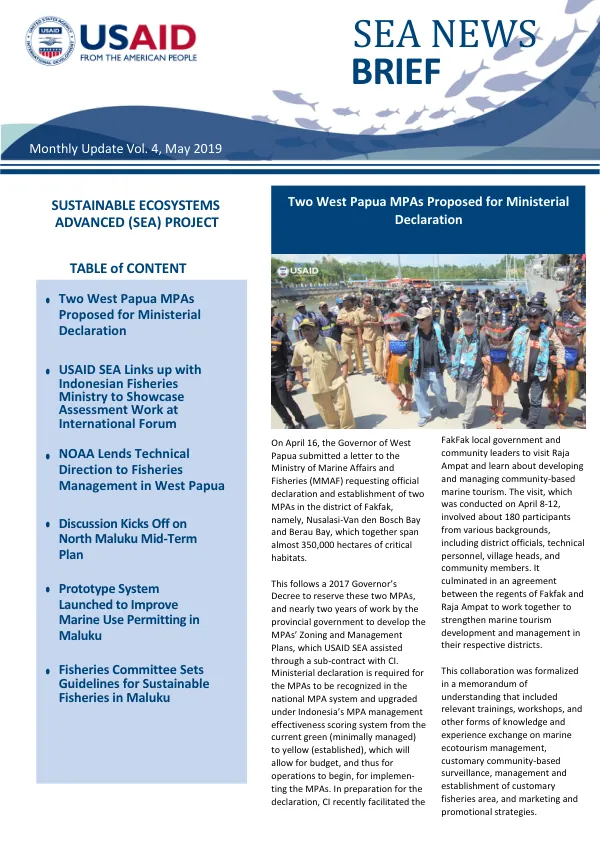
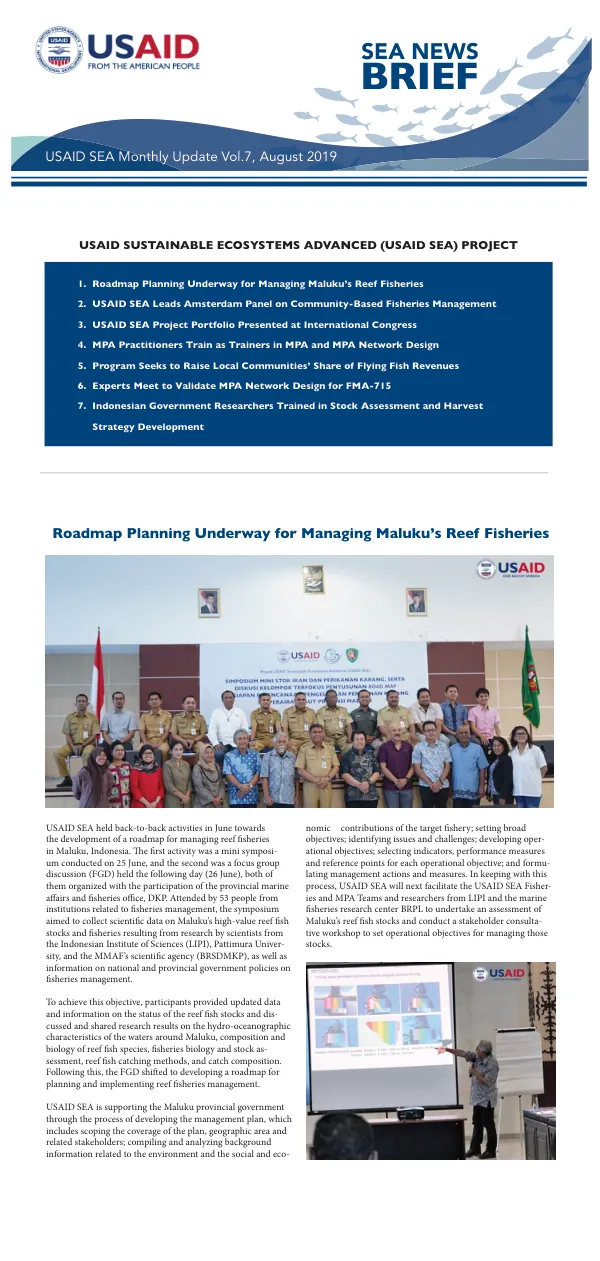
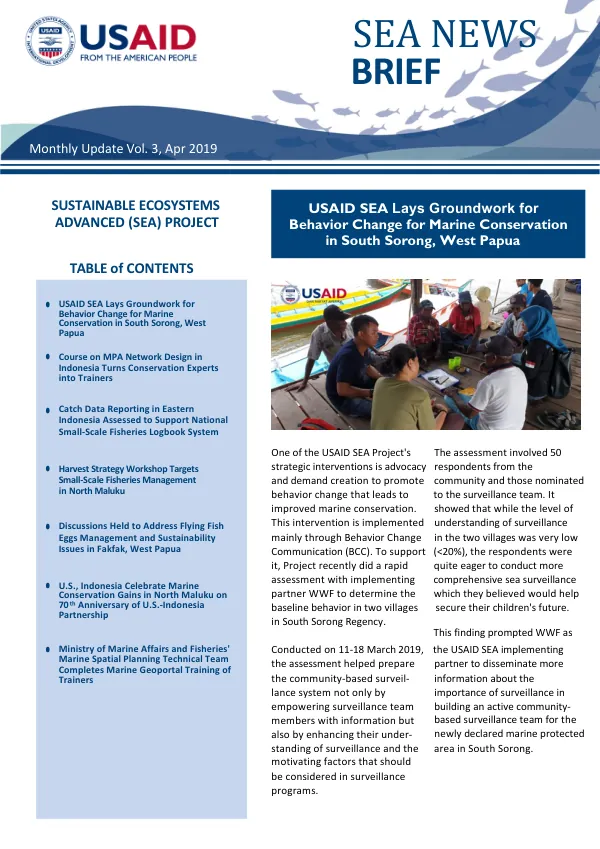
Monthly Update Vol. 3, Apr 2019: SUSTAINABLE ECOSYSTEMS ADVANCED (SEA) PROJECT
The USAID SEA Project, a project aimed at promoting sustainable ecosystems, has been working in Indonesia since its inception in 2018.
2019 · 6 pages
Sign in to readA free account is required to download.
Abstract
The project's main focus is on marine conservation, with a specific emphasis on promoting behavior change that leads to improved marine conservation. One of the project's strategic interventions is advocacy and demand creation, which is implemented through Behavior Change Communication (BCC). To support this intervention, the project conducted a rapid assessment with implementing partner WWF to determine the baseline behavior in two villages in South Sorong Regency. The assessment, conducted from March 11 to 18, 2019, involved 50 respondents from the community and those nominated to the surveillance team. The results showed that while the level of understanding of surveillance in the two villages was very low, the respondents were eager to conduct more comprehensive sea surveillance, which they believed would help secure their children's future. This finding prompted WWF to disseminate more information about the importance of surveillance in building an active community-based surveillance team for the newly declared marine protected area in South Sorong. The USAID SEA Project also piloted a Training of Trainers on March 19-22, 2019, in Jakarta, to review and strengthen the Ministry of Marine Affairs and Fisheries Network Design Module. The training was designed to integrate content and integrate content and delivery methods, targeting Marine Affairs and Fisheries, academe, and academe, with advanced skills in marine protected area (MPA) and MPA Network design. The training covered topics such as defining MPA goals and objectives, identifying MPA design criteria, and evaluating an MPA design. As part of the USAID SEA Project's support for the Indonesian Government's initiative to establish a logbook system for small-scale fisheries, the project conducted a field assessment of the mechanisms for reporting catch data in North Maluku and West Papua. The assessment, conducted from March 8 to 20, 2019, involved 50 respondents from fishing communities, including middlemen, fishers, and fishers' wives, and was supported by researchers from Bogor Agricultural University. The assessment aimed to identify the best institutional data management mechanism, integrate the community and national-level government, and determine the incentives for compliance with the requirements for reporting catch data. The USAID SEA Project also conducted a harvest strategy workshop on March 25-28, 2019, in Ternate, North Maluku, to identify operational objectives and indicators for managing Indonesia's small-scale fisheries. The workshop was conducted with the Ministry of Marine Affairs and Fisheries-Directorate of Fisheries Resources Management and involved 44 participants representing FMA 715 stakeholders, academe, and the private sector in Maluku, North Maluku, West Papua, Gorontalo, North Sulawesi, and Central Sulawesi Provinces. The workshop resulted in primary management objectives that would lead to an increase in catch per unit effort (CPUE) and accomplish the objectives are still pending, but the workshop was a big step to build the capacities of local universities that can play critical advisory roles for the future of fisheries in this part of Indonesia. In Fakfak, West Papua, the USAID SEA Project, through its implementing partner, the University of Papua (UNIPA), facilitated a Focus Group Discussion (FGD) on Flying Fish Eggs Management. The FGD, held on April 4-5, 2019, involved 44 respondents from the Marine and Fisheries Office, Regional Planning Agency, Directorate-General of Marine and Fisheries Resources Surveillance, Agricultural Department, Conservation International, and temporary fishers from South Sulawesi and the private sector. The discussions resulted in tangible recommendations, such as setting a limit on the number of fishing days, adhering to conservation guidelines, and regulating the number of fishing resources. These recommendations will help reduce overexploitation of flying fish eggs, and UNIPA will develop and refine the actions so that regulations at the provincial level in South Sulawesi and West Papua can be developed. The U.S. Ambassador, USAID Indonesia Mission Director, and U.S. Consulate General Surabaya celebrated the 70th anniversary of diplomatic relations between the U.S. and Indonesia in North Maluku on April 1-3, 2019. The maritime and fisheries sector was the main focus of cooperation highlighted by the two countries. The visit reflected the successes of the long U.S.-Indonesian partnership to protect biodiversity and enhance Indonesia's management of valuable marine resources. During the visit, the USAID SEA Project and the Morotai Island local government hosted a ceremonial event at the Morotai Regent Office to declare the reservation of three new marine protected areas (MPAs) in North Maluku Province. The U.S. Ambassador, Morotai Island Regent, and Vice Governor of North Maluku proudly declared the reservation of three MPAs covering 226,000 hectares, including Sula Island, Rao-Tung Dahegila, and Makir Island.
Related documents